9 Things to Look for Before Buying a Portable Oxygen Concentrator in 2026

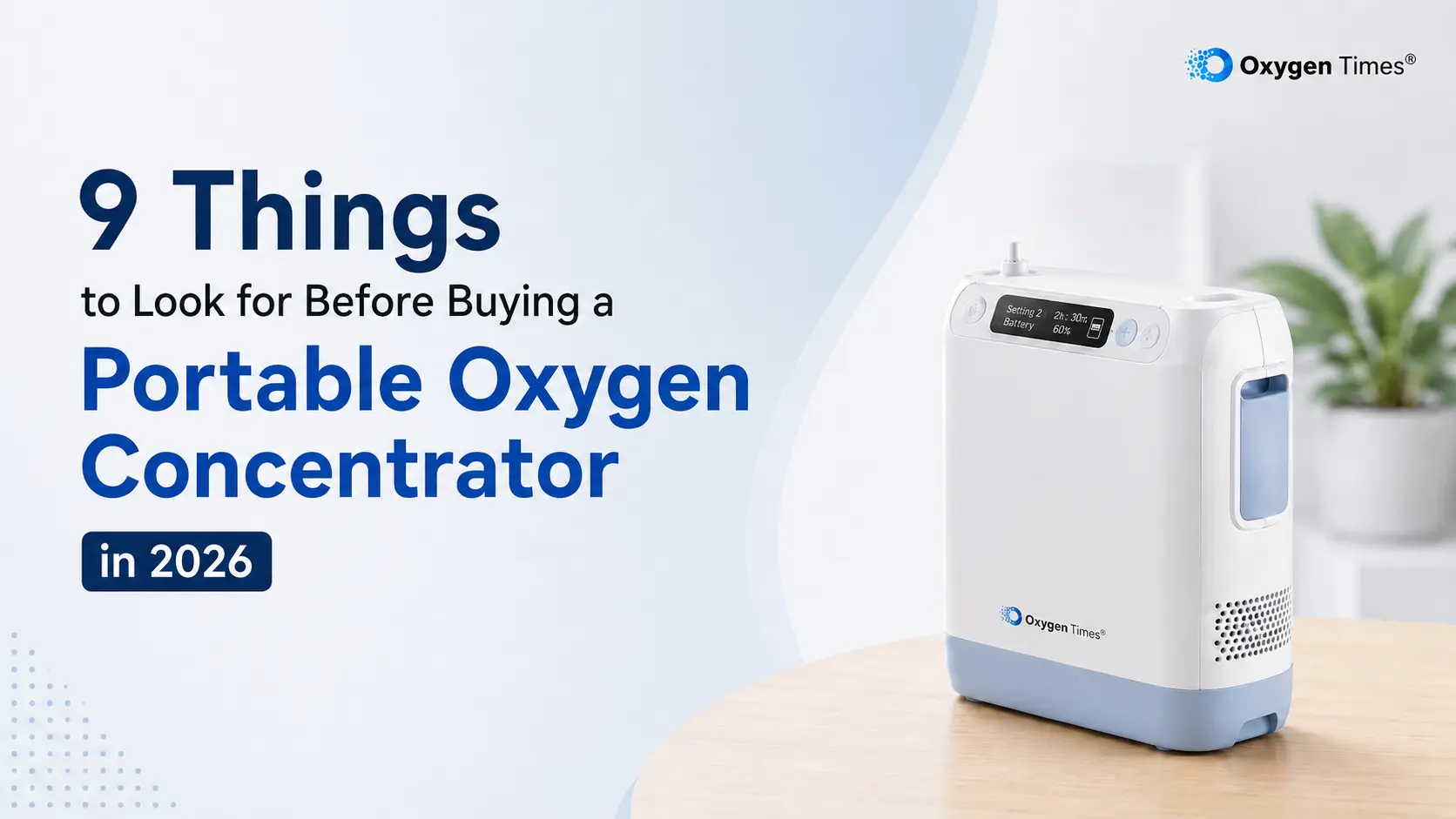
Buying a portable oxygen concentrator is a big decision, especially when it is for a patient who needs oxygen support outside the home. The machine has to be easy to carry, give reliable oxygen support, and remain practical to maintain over the long term.
Most buyers first compare price, weight, and advertised battery backup. But in real life, these numbers do not tell the full story. A POC that looks good on paper may not be the right choice if the battery backup drops at higher settings, replacement batteries are expensive, spare parts are difficult to arrange, or service support is weak.
That is why it is important to look at the full ownership experience before buying. From oxygen delivery type and battery cost to sieve beds, service support, airline approval, and warranty, each factor can affect how useful the machine will be after purchase.
Here are the 9 most important things to look for before buying a portable oxygen concentrator in 2026.
Key Takeaways
- Pulse-flow POCs work well for most users unless the doctor specifically prescribes continuous flow. For regular daytime mobility, pulse dose is usually the preferred portable option.
- Do not rely only on “up to” battery backup. Battery backup changes at different pulse settings. A machine may give long backup at setting 1, but much lower backup at higher settings, so check backup at the lowest and highest setting (usually 5 or 6).
- Battery price matters in long-term ownership. Indian origin brands like Oxysure and Oxymed provide excellent value because replacement batteries usually cost around ₹22,000 to ₹25,000, while many premium international brand batteries can cost around ₹50,000 to ₹70,000.
- For air travel, battery planning is important. Many airlines require battery backup for around 150% of the flight duration, so frequent travellers may need multiple spare batteries depending on flight time and oxygen setting.
- Choose a lightweight machine. For most patients, portable oxygen concentrators below around 2.4 kg with a single battery installed are easier to carry for daily use, hospital visits, and travel.
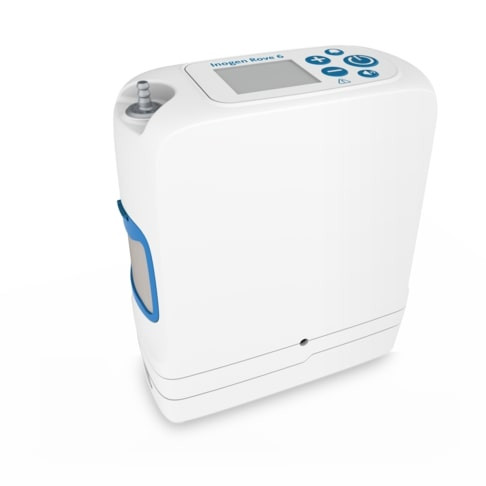
- Look for user-replaceable sieve beds. Models like Inogen Rove 6 and Oxysure Go allow easier sieve bed replacement, which can reduce downtime and long-term maintenance cost.
- Check service support across India. Brands like Philips Respironics, Oxysure, and Oxymed have widespread and reliable service support across India, which is important for warranty, repairs, and spare-part availability.
- Buy a Portable Oxygen Concentrator (POC) approved for air travel. Prefer batteries rated below 100Wh each, as they are generally accepted by airlines without special approval.
- Beware of cheap portable oxygen concentrators. While they may look similar from the outside, the quality of the compressor and sieve beds varies significantly. Poor-quality machines often have limited spare parts availability, making repairs difficult or impossible.
- Prefer models with atleast 2–3 years warranty. A longer warranty usually shows better confidence in the product and gives the buyer more protection during long-term use.
1. Pulse Dose or Continuous Flow Oxygen Delivery
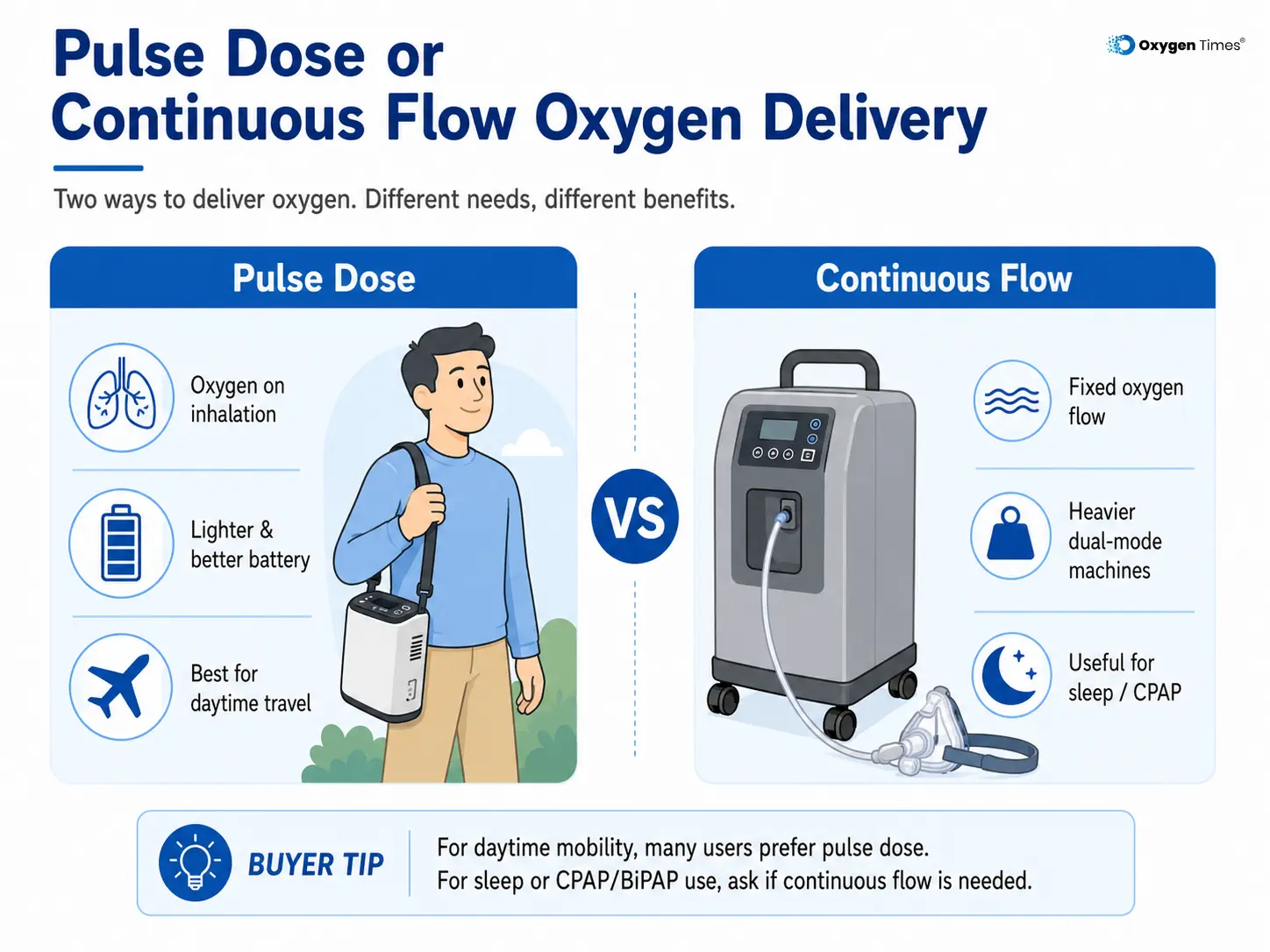
Before buying a portable oxygen concentrator, the first thing to understand is whether the patient needs pulse dose oxygen delivery or continuous flow oxygen delivery.
Most lightweight portable oxygen concentrators use pulse dose, also called on-demand flow. In pulse dose mode, the machine delivers oxygen only when it detects inhalation.
This helps save battery because oxygen is not continuously released while the patient is breathing out. Since the machine does not need to deliver oxygen continuously, pulse-dose POCs can be made smaller, lighter, and more battery-efficient.
Popular pulse-dose portable oxygen concentrators include:
- Inogen Rove 6
- Oxysure Go
- Oxymed P2
- CAIRE FreeStyle Comfort
- Philips Respironics SimplyGo Mini
- DeVilbiss iGo2
For many respiratory patients, including many COPD users, doctors commonly recommend lightweight pulse-dose POCs for daytime mobility and travel, depending on the patient’s oxygen requirement and SpO₂ response.
When Continuous Flow May Be Needed
Continuous-flow oxygen concentrators deliver oxygen at a fixed flow rate, similar to a home oxygen concentrator.
Home oxygen concentrators are usually bulky because continuous oxygen delivery requires a larger system. In portable concentrators also, models that provide both pulse dose and continuous flow are usually much heavier.
Dual-mode portable oxygen concentrators typically weigh around 4.4 kg to 8 kg. Because of this, they usually come with a roller cart instead of being carried on the shoulder.
Some examples of dual-mode or continuous-flow portable oxygen concentrators include:
- Philips Respironics SimplyGo
- SeQual Eclipse 5
- Oxlife Independence
Continuous flow may be needed when the patient needs oxygen during sleep or wants to use oxygen with CPAP/BiPAP. In CPAP/BiPAP use, the oxygen tube is usually connected into the PAP circuit, so continuous flow is generally preferred.
During sleep, some patients may breathe through the mouth, and pulse-dose machines may not reliably detect every breath. Also, pulse-dose machines are usually used with a nasal cannula, while continuous flow can be used with an oxygen mask when required.
2. Real Battery Backup at Your Required Setting
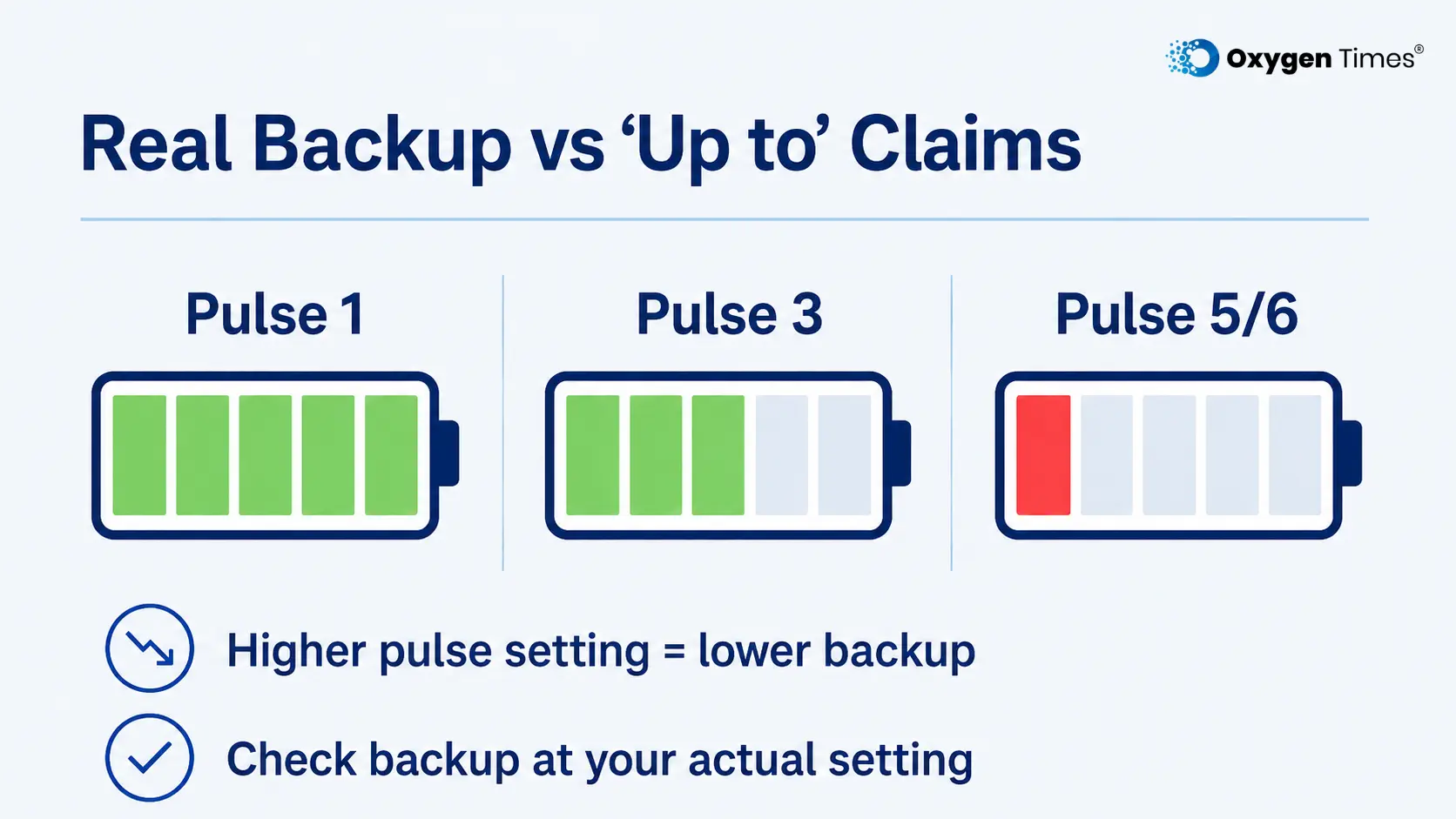
Battery backup is one of the most important things to check before buying a portable oxygen concentrator. But buyers should not rely only on the maximum backup mentioned in brochures.
Most brands mention battery backup as an “up to” value. For example, a machine may say “up to 10 hours” or “up to 12 hours”. But this backup is usually calculated at the lowest pulse setting, often setting 1.
As the pulse setting increases, battery backup decreases.
So if a patient uses the machine at setting 3, 4, 5, or 6, the actual backup can be much lower than the maximum backup mentioned in the brochure.
Do Not Fall for Only “Up To” Battery Backup
Before buying, always ask:
- What is the battery backup at the user’s prescribed setting?
- Is the backup mentioned for single battery or double battery?
- How much backup will the patient get at setting 3, 4, or 5?
- How many batteries will be needed for daily outdoor use?
- How much backup is needed for travel or flights?
A portable oxygen concentrator with long backup at setting 1 may not be the best choice if the user needs a higher pulse setting.
Buyer Tip:
Always compare battery backup at the patient’s actual oxygen setting, not only the highest “up to” backup mentioned in the brochure. If you need help understanding the battery backup at your prescribed settings, feel free to reach out to our consultants using the buttons below.
3. Battery Price
Battery price can make a big difference in the long-term cost of owning a portable oxygen concentrator.
In many premium American portable oxygen concentrators, replacement batteries can cost around ₹50,000 to ₹70,000, depending on the model and battery type.
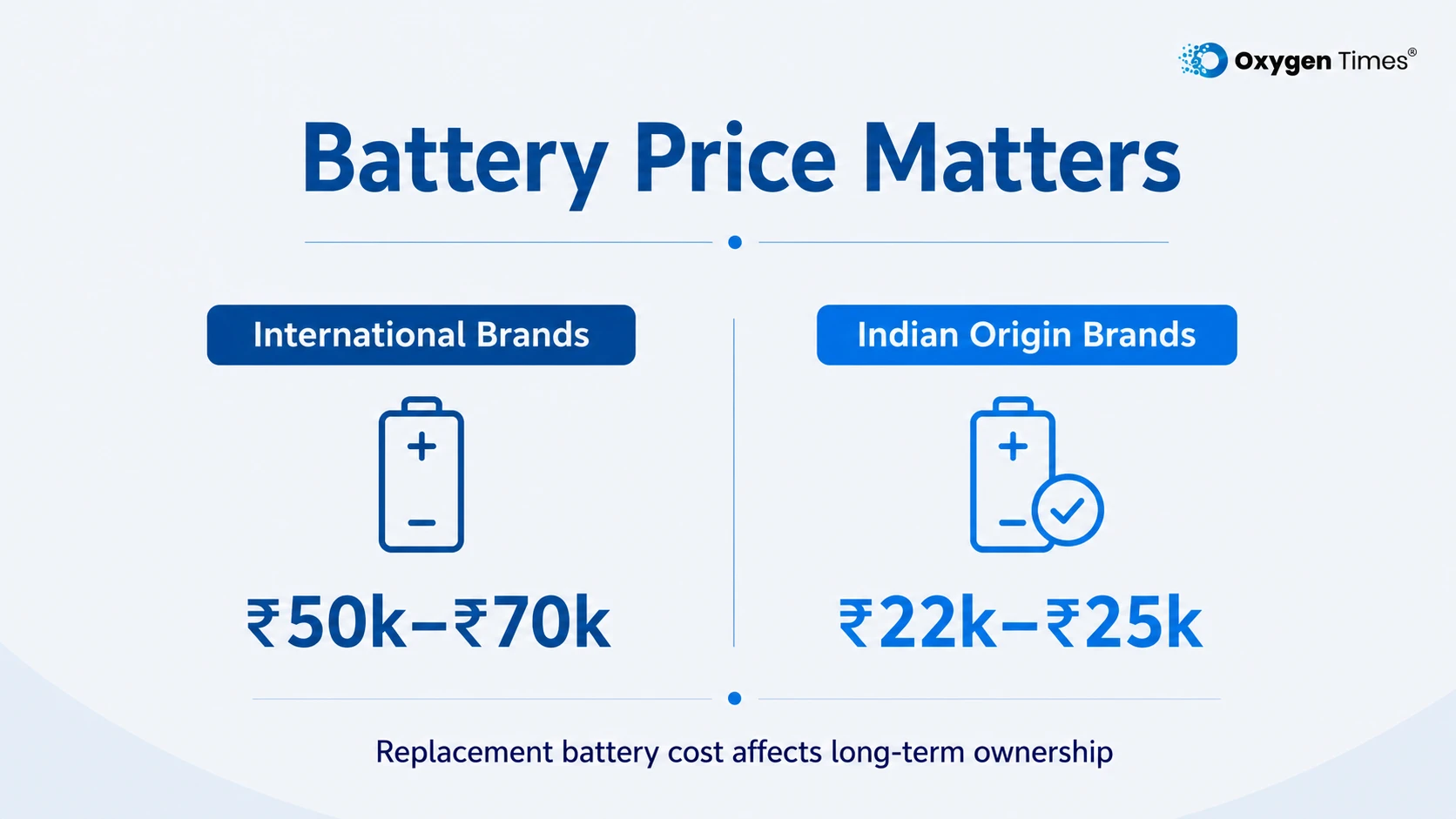
In comparison, brands such as Oxysure and Oxymed usually have battery prices around ₹22,000 to ₹25,000, making them more affordable for long-term use in India.
This matters because most regular users eventually need an extra battery or a replacement battery. For patients who travel frequently or use the machine outdoors, battery cost becomes even more important because they may need more than one battery.
Battery Planning for Air Travel
For travel or long outdoor use, battery planning becomes even more important.
Many airlines require users to carry enough fully charged batteries for 150% of the expected flight duration. For example, for a 10-hour flight, the user may need around 15 hours of battery backup based on the prescribed flow or pulse setting.
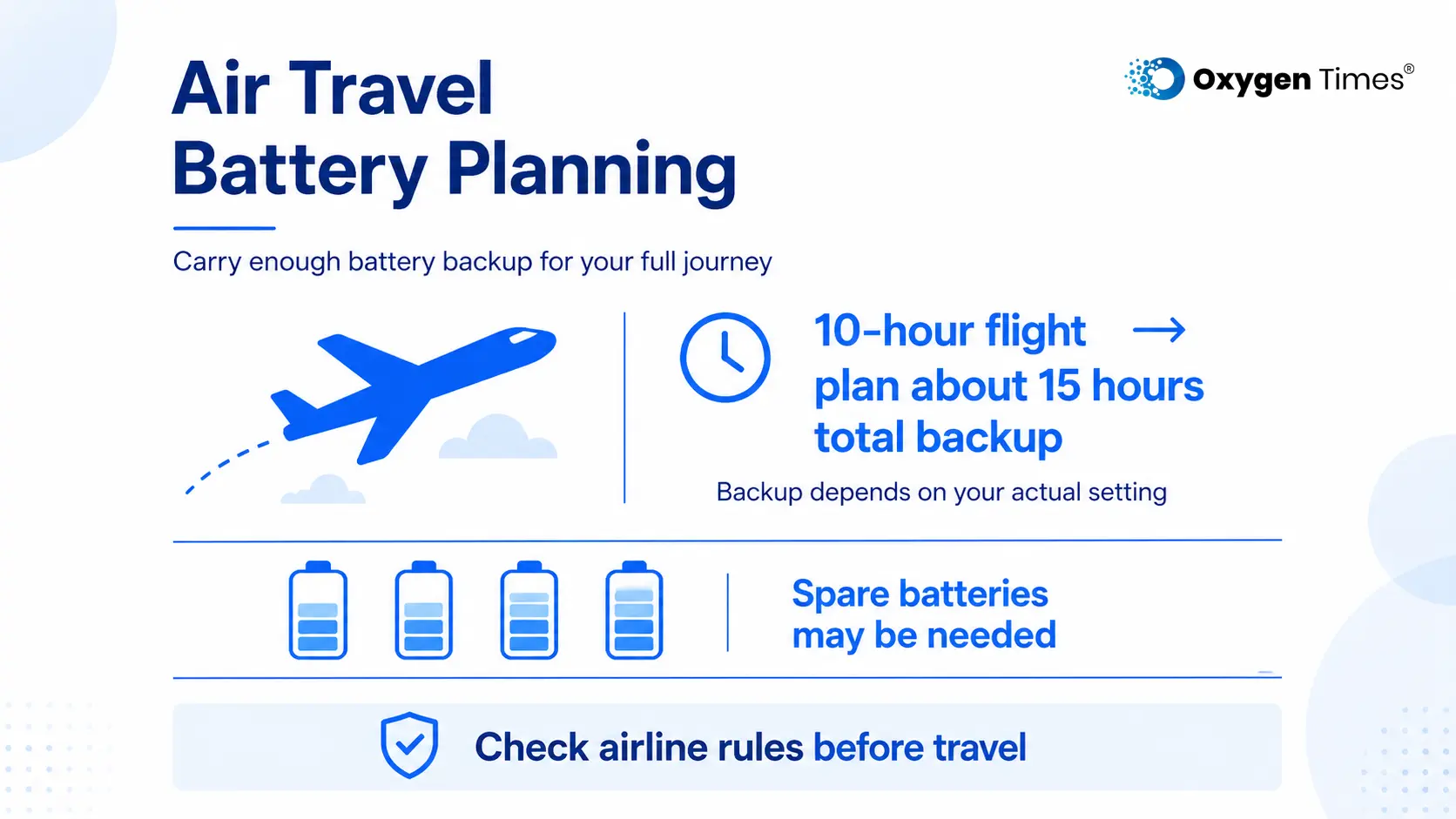
This means a patient may need 2 to 4 spare batteries depending on:
- Flight duration
- Oxygen setting
- Battery backup at that setting
- Layovers and delays
So before buying a POC for travel, check the battery price, battery backup at your setting, and number of spare batteries needed together.
Before buying, ask:
- What is the cost of one replacement battery?
- Is a double battery option available?
- How much will future battery replacement cost?
- Are batteries easily available in India?
- How many spare batteries may be needed for travel?
Buyer Tip:
A portable oxygen concentrator with affordable replacement batteries can be much easier to manage in the long run than a machine with very expensive batteries, especially for users who travel frequently or need longer outdoor backup.
4. Charging Time
Battery backup is important, but charging time is equally important.
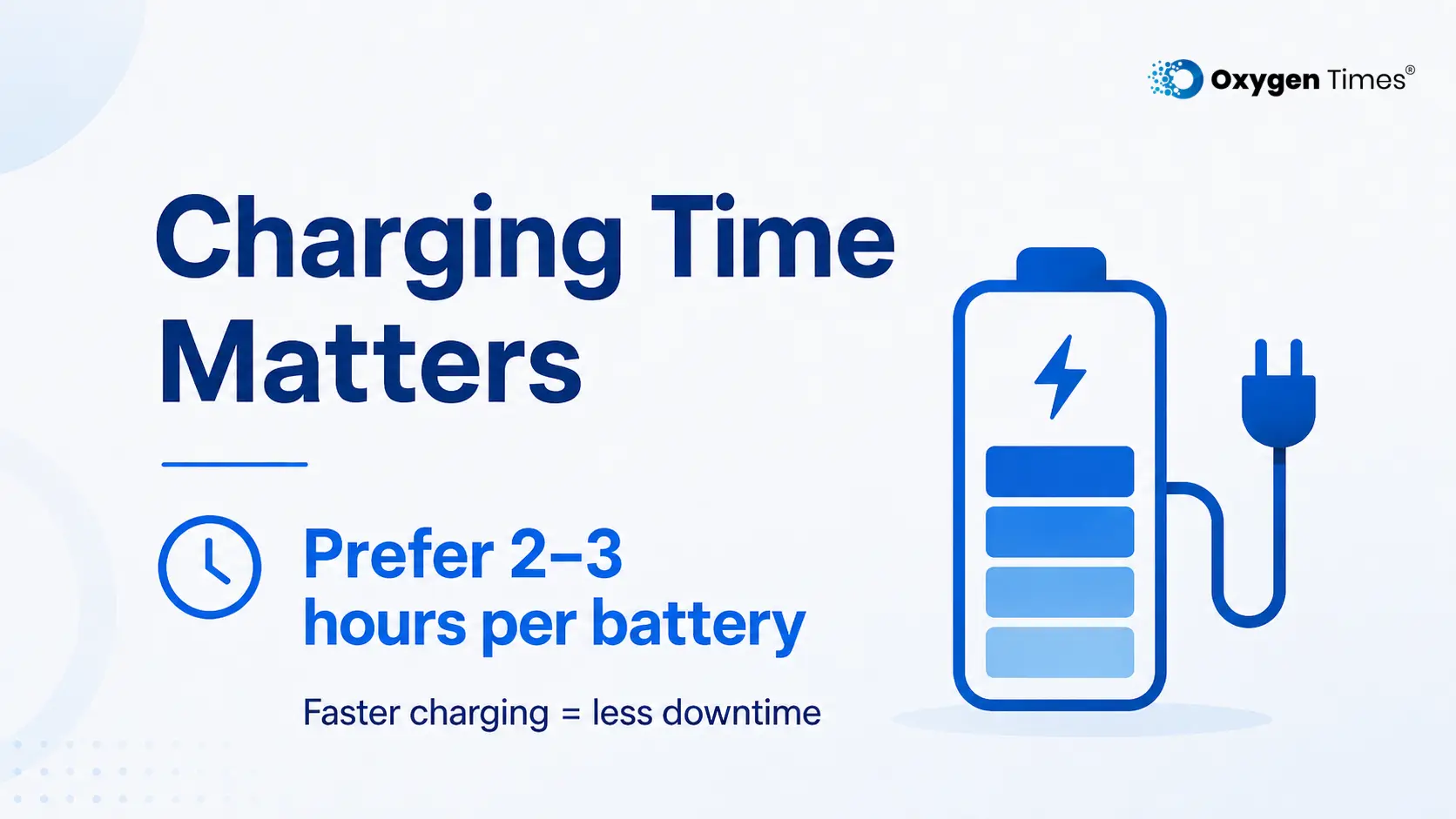
A battery that takes 4–5 hours to charge can become inconvenient for users who travel frequently or use the machine outdoors. For most users, a charging time of around 2–3 hours per battery is more practical.
A fast-charging battery reduces downtime and makes the device easier to use during travel, hospital visits, and daily outdoor movement.
Before buying, ask:
- How long does one battery take to charge?
- Does the machine support car charging?
Buyer Tip:
A POC with faster charging can be more convenient for regular outdoor use and travel than a machine with slow charging.
5. Weight With Battery Installed
Weight is one of the biggest comfort factors in a portable oxygen concentrator, especially for respiratory patients.
Many oxygen users already feel breathless while walking, climbing stairs, or moving outdoors. If the machine is heavy, the extra carrying load can make them feel more tired and may increase shortness of breath during movement.
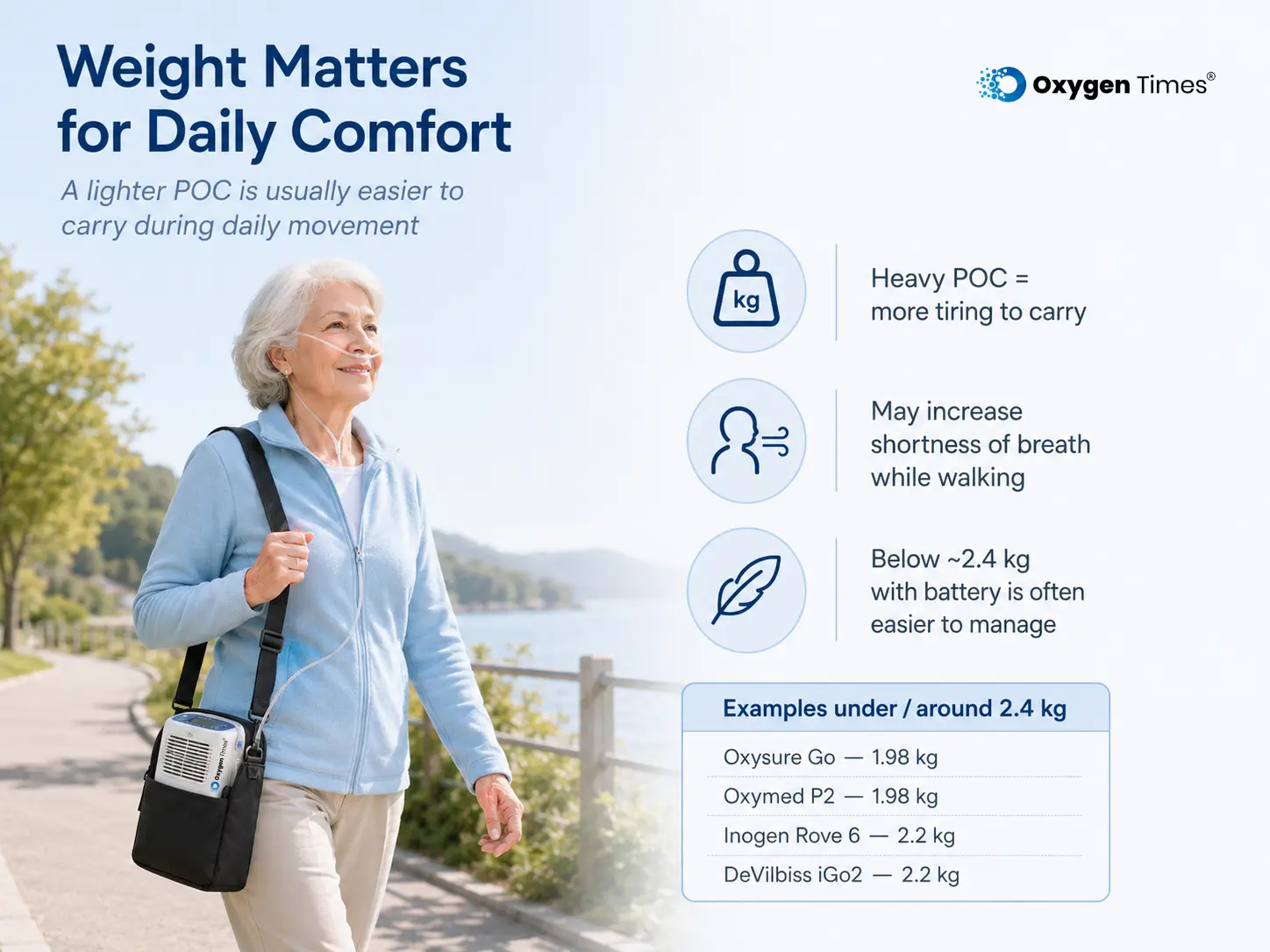
This is why a portable oxygen concentrator should not only match the patient’s oxygen requirement, but should also be physically comfortable to carry.
Based on our observation at Oxygen Times, most patients prefer portable oxygen concentrators that weigh around 2.4 kg or below with a single/standard battery installed, especially for daily outdoor use, hospital visits, and travel. This weight range is generally easier to manage for users who experience breathlessness during movement.
Some of the major portable oxygen concentrator models under or around this preferred weight range include:
- Oxysure Go – 1.98 kg
- Oxymed P2 – 1.98 kg
- Inogen Rove 6 – 2.2 kg
- DeVilbiss iGo2 – 2.2 kg
Machines heavier than this can still be suitable for some users, depending on their oxygen requirement and usage pattern. However, they may feel less comfortable for elderly patients or users who need to carry the device for longer periods.
Always Check Weight With Battery
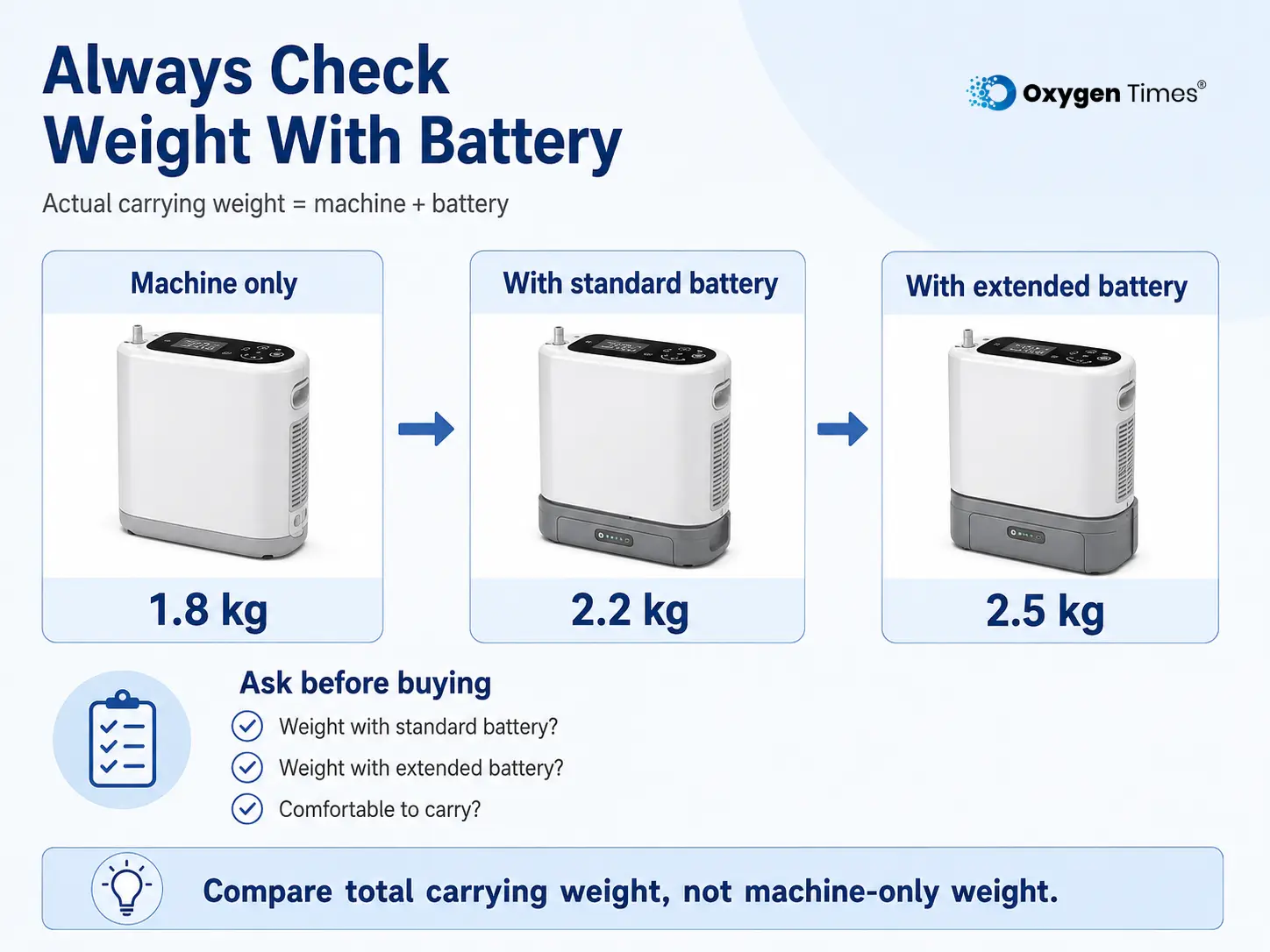
Some brands mention the machine weight without battery. This can make the device look lighter on paper.
But in real life, the patient will use the machine with the battery installed. So the actual carrying weight is the machine plus battery, not the machine body alone.
Before buying, always ask:
- What is the machine weight with standard battery?
- What is the weight with extended battery?
- Does the carry bag feel comfortable?
- Can the user carry it on the shoulder for 20–30 minutes?
- Is a trolley option available?
Buyer Tip:
For most respiratory patients, a POC under around 2.4 kg with a single/standard battery is easier to manage for daily movement and travel. Always compare the weight with battery installed, not machine-only weight.
6. User-Replaceable Sieve Beds
Portable oxygen concentrators with user-replaceable sieve beds are easier to maintain in the long run.
Sieve beds are one of the most important internal parts of an oxygen concentrator. They help the machine separate oxygen from room air and maintain oxygen purity.
Over time, sieve beds can lose efficiency and may need replacement. This is a normal part of long-term oxygen concentrator ownership.
The important question is: can the user replace the sieve beds at home, or does the machine need to go to a service centre?
They allow the user or caregiver to replace the sieve beds without repeatedly sending the machine to a service centre, depending on the model’s design and instructions.
This is especially useful for:
- Long-term oxygen users
- Frequent travellers
- Users living outside metro cities
- Patients who want lower downtime
- Families who want more control over maintenance
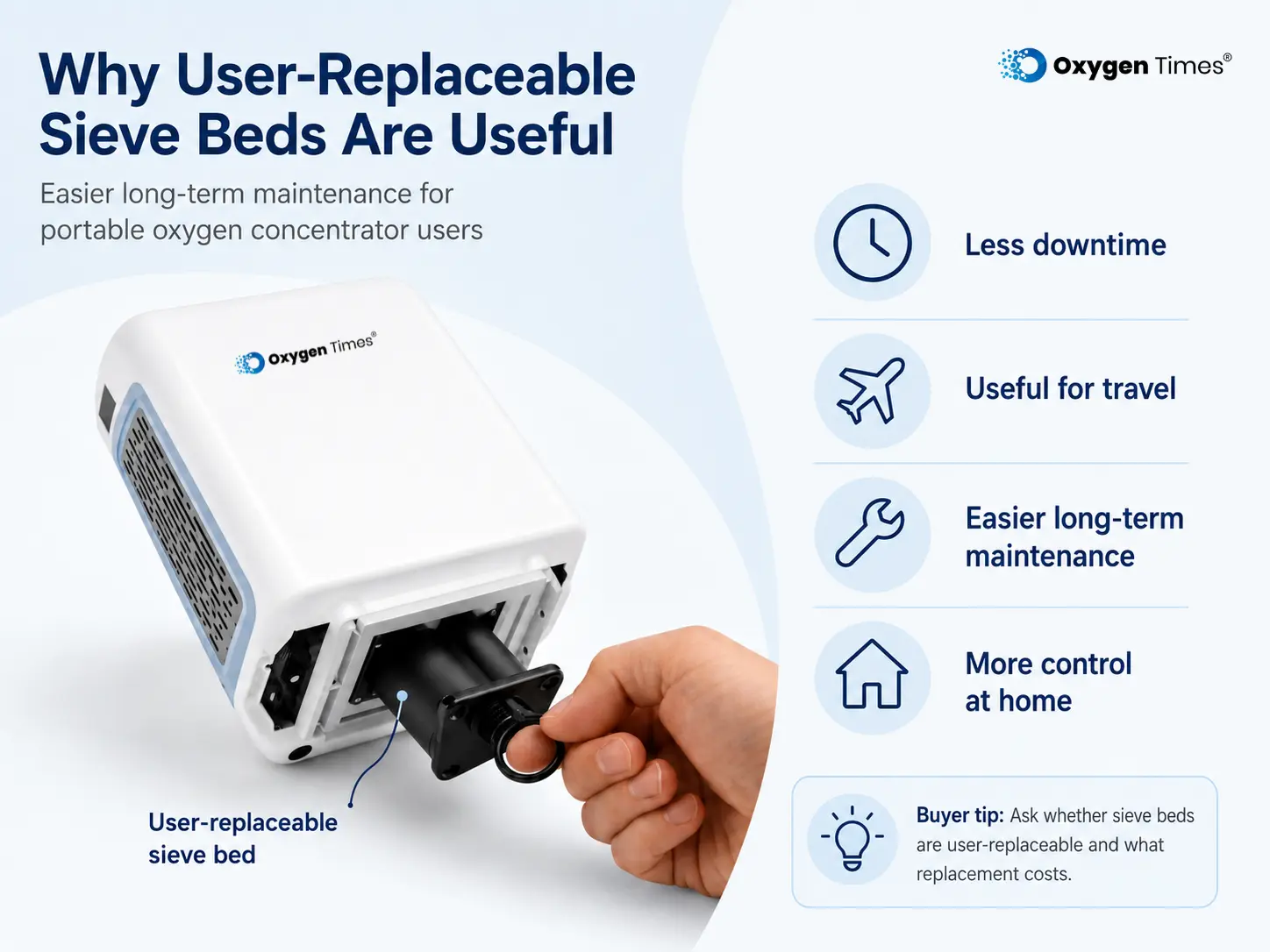
In many cases, user-replaceable sieve beds can also help reduce long-term service expenses. Since the machine does not always need to be sent to a service centre for sieve bed replacement, many users may save around ₹10,000 to ₹15,000 in service-related costs over time.
Some models, such as Inogen Rove 6 and Oxysure Go, offer user-replaceable sieve beds. Many other portable oxygen concentrators require service-centre replacement.
Before buying a POC, also ask about the price of key spare parts such as:
- Battery
- Sieve beds
- Filters
These parts directly affect the long-term ownership cost of the machine.
Buyer Tip:
If you are buying a POC for long-term use, ask whether the sieve beds are user-replaceable, how much replacement costs, and whether important spare parts like the battery, sieve beds, and filters are easily available.
7. Brand Availability, Spare Parts, and Service Support in India
A global brand name does not always mean easy service in India.
Many international brands enter India through distributors. Sometimes, after a few years, the distributor changes or stops actively supporting the product. When this happens, users may face difficulty getting batteries, chargers, sieve beds, filters, repair parts, warranty support, and timely service.
This is a common issue with imported devices of international brands.
A machine may be excellent technically, but if spare parts and service support are not available in India, it becomes difficult to maintain in the long run.
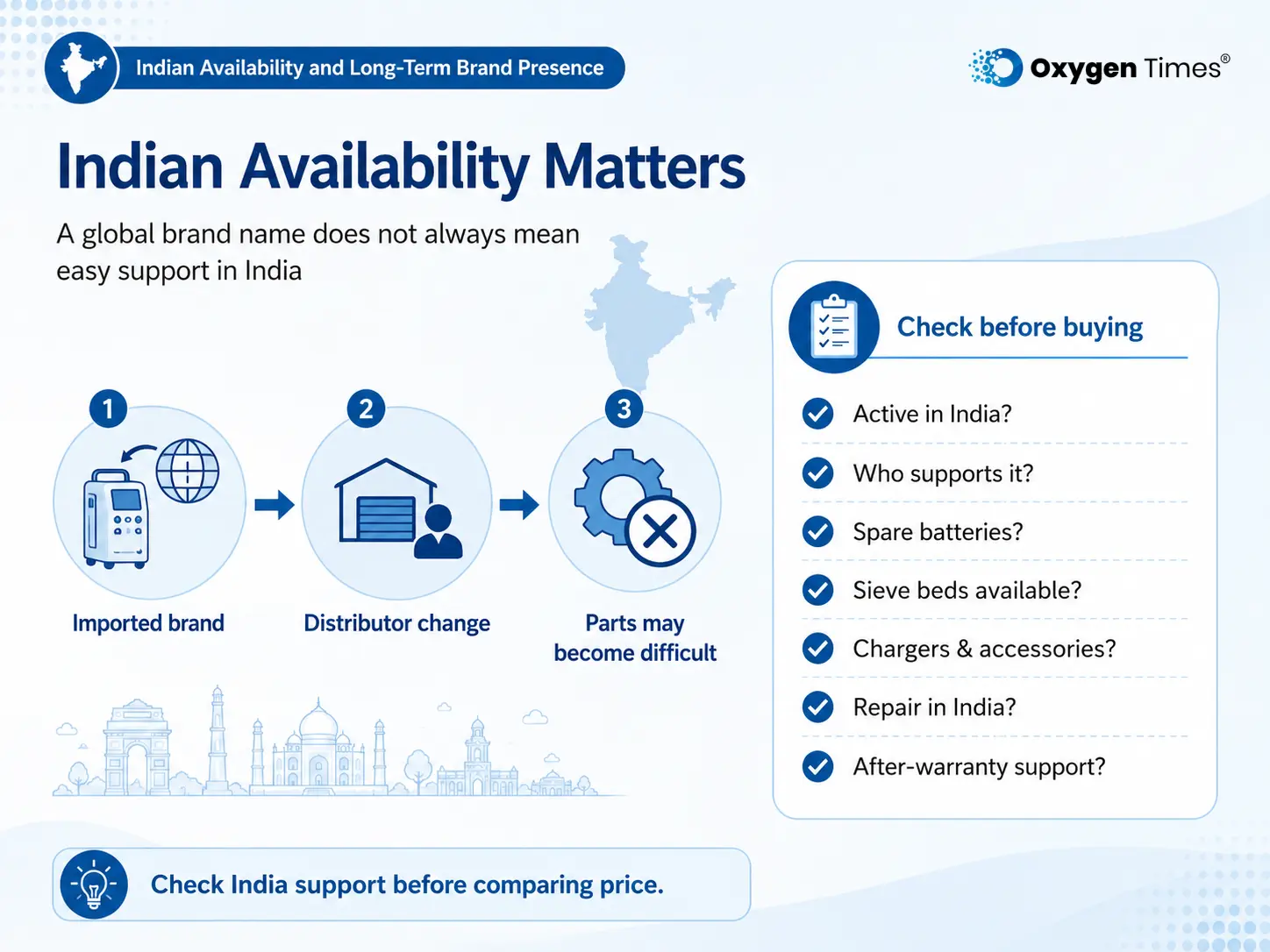
Check Whether the Brand Is Actively Supported in India
For Indian buyers, brand presence in India is very important. Brands with Indian-origin operations, such as Oxysure and Oxymed, may offer better long-term convenience because their products, spare parts, and service support are more focused on Indian users.
Similarly, global healthcare brands such as Philips Respironics can also be a good option when they have an active registered presence, service structure, and spare-part support in India.
The key point is not whether the brand is Indian or global. The key point is whether the brand has reliable support in India after purchase.
Know Who Handles Service: Company or Distributor
Service support is one of the most important things to check before buying a portable oxygen concentrator.
There are usually two types of service models:
- Company-operated service
- Distributor-operated service
Both can work, but the buyer should understand who is responsible for warranty, repair, spare parts, and long-term support.
In distributor-operated service, support depends heavily on the distributor. If the distributor changes, stops importing the product, or does not stock parts, the user may face problems later.
In company-operated or India-focused service models, support may be more stable because the brand or company is directly involved in customer service and spare-part management.
This is why many Indian buyers prefer brands with a clearer service presence in India. Brands such as Oxysure, Oxymed, and Philips Respironics have stronger India-focused availability compared to many imported brands that depend mainly on changing distributor networks.
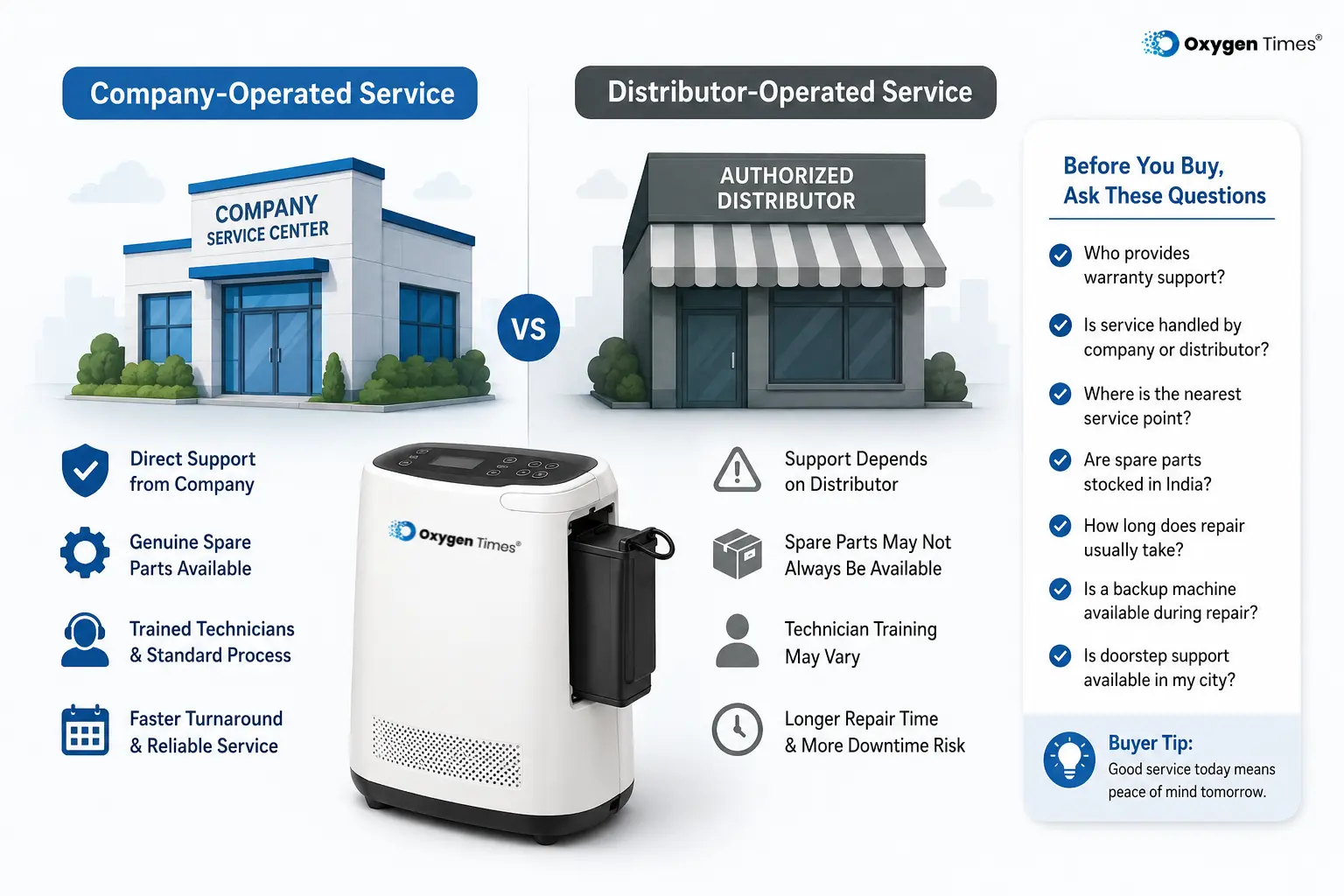
Before buying a portable oxygen concentrator, ask:
- Is the brand currently active in India?
- Does the brand have Indian-origin or registered India presence?
- Who provides warranty support?
- Is service handled by the company or distributor?
- Are important spare parts like batteries, sieve beds, filters, chargers, and accessories available in India?
- Is a backup machine available during repair?
- Is doorstep support available in my city?
- What happens after warranty?
Some older imported models have become difficult to support in India because of limited spare-part availability or distributor changes. This is why Indian availability should be checked before buying, especially for expensive imported POCs.
For oxygen therapy users, downtime can be stressful. So service support should be checked before comparing final prices.
Buyer Tip:
Do not buy only because the brand is famous globally. Buy a model from a brand that has current service, spare parts, and warranty support in India. Indian-origin brands and global brands with proper India presence are generally safer to consider than imported models with unclear long-term support. A slightly cheaper machine may become expensive later if service is slow or spare parts are unavailable.
8. Airline Approval and Battery Permission
Many buyers ask whether a portable oxygen concentrator is airline-approved before travelling. This is an important question, but it is not the only thing to check.
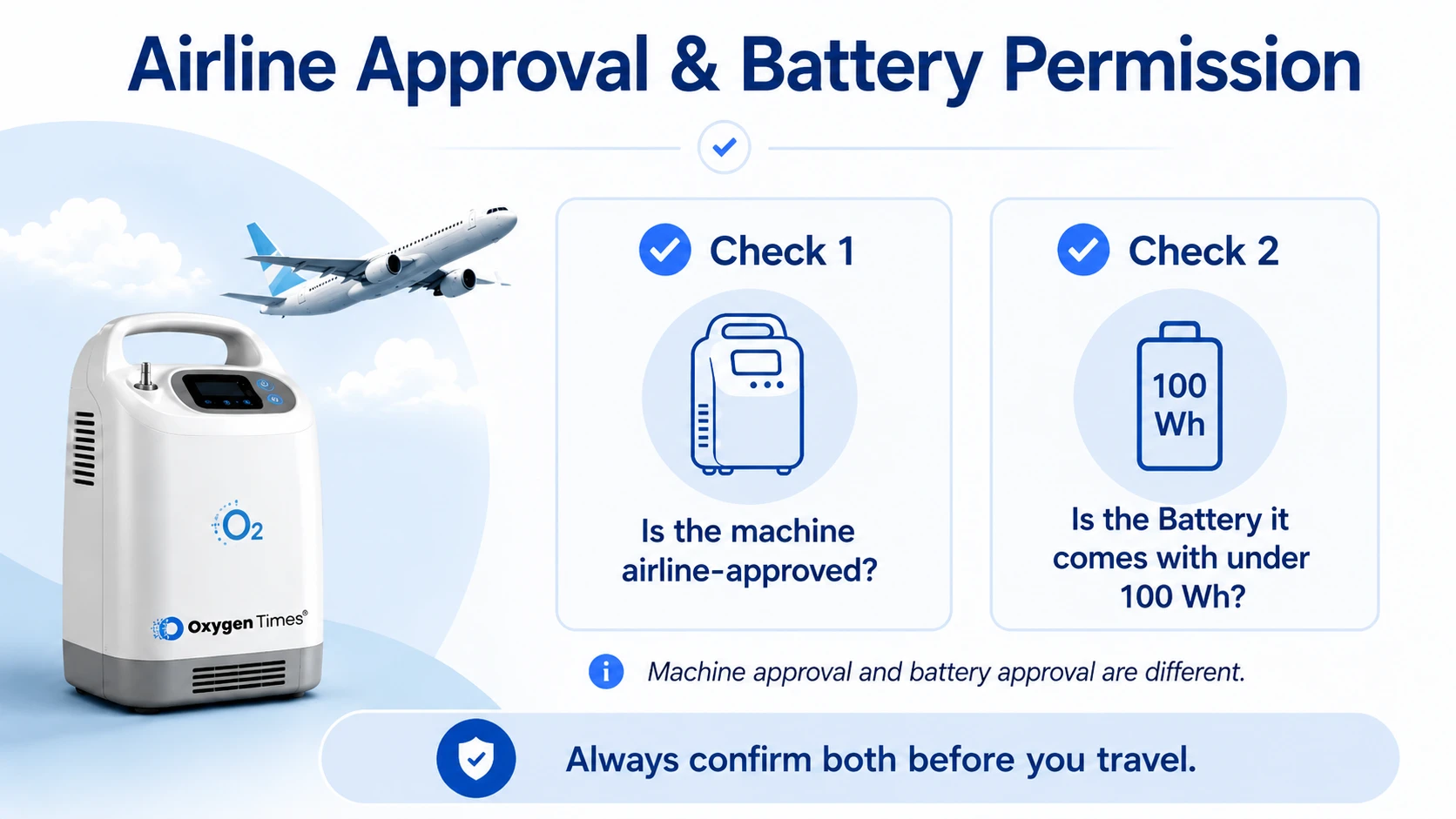
In the past, many people relied on older approved-model lists before travelling with a portable oxygen concentrator. However, many models on older lists belong to older generations from brands such as Philips Respironics, Inogen, and AirSep. Some of these models are now discontinued or are 10–15 years old.
This creates confusion because many newer portable oxygen concentrators may not appear in those older lists, even though they may still be used for air travel when they meet the required aviation safety conditions.
Older Approved Lists Can Create Confusion
If a newer model is not visible in an older approved-model list, it does not automatically mean that the machine cannot be used on a flight.
In some cases, even airline staff may still refer to older model lists and create confusion. At Oxygen Times, we have seen that in a small number of cases, around 2 out of every 100 travelling patients, the airline initially questions or rejects the machine because the model name is not visible in an older list.
This usually happens because airline staff may not always be updated with the latest process for portable oxygen concentrators. They may assume that if the model is not on the old list, it is not accepted for onboard use.
In such cases, we recommend patients carry the product documents, airline travel documents, and official manufacturer information before travelling.
Before travelling, users should confirm the exact portable oxygen concentrator model with the airline and carry the documents suggested by the airline. If there is any confusion, feel free to reach out to our consultants using the buttons below.
When a POC is purchased from Oxygen Times, we can also provide supporting travel documentation in such cases for added protection and smoother communication with the airline.
Airline Approval Is Not the Same as Battery Permission
Even if the portable oxygen concentrator is airline-approved, the battery still needs to follow lithium battery rules.
You also need to check the battery watt-hour rating.
Some machines may be airline-approved, but their extended batteries may create issues if the battery capacity is too high.
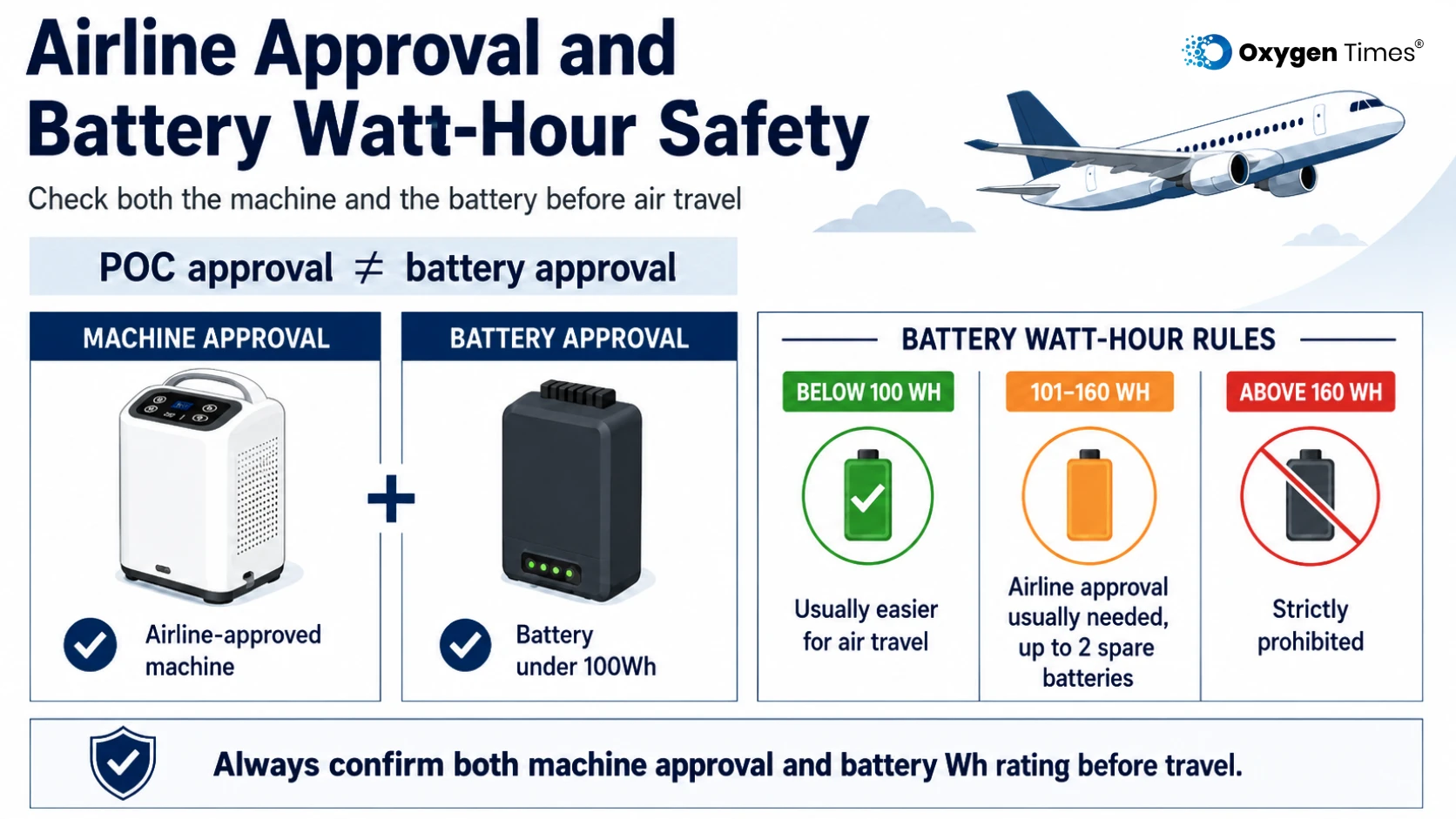
A POC may be approved for airline use, but the battery still needs to follow airline lithium battery rules.
According to official battery guidance, lithium-ion rechargeable batteries are generally limited to 100 Wh per battery. Batteries between 101 Wh and 160 Wh usually need airline approval and are limited to two spare batteries. Batteries above 160 Wh are generally not allowed for passenger air travel.
This is why buyers should check both:
- Whether the POC model is airline-approved
- Whether the battery watt-hour rating is allowed by the airline
- Whether the battery is below 100 Wh
- If it is 101–160 Wh, whether the airline has approved it
- Whether the battery is allowed in cabin baggage
- How many spare batteries can be carried
Large Batteries Can Create Travel Problems
Some companies use large-capacity batteries to show longer battery backup. While this may look attractive on paper, it can create problems during air travel if the battery watt-hour rating exceeds airline limits.
This is something we have seen in real cases at Oxygen Times.
In our experience, some patients travelling with major international airlines, including Singapore Airlines and Emirates, were not allowed to carry large-capacity batteries despite having airline approval documents for the portable oxygen concentrator itself. The issue was not always the machine approval; in these cases, the concern was the battery capacity.
This usually happens with large extended batteries, especially high-capacity batteries such as 16-cell batteries, where the watt-hour rating may be above the permitted airline limit. Many users assume that if the POC is airline-approved, all its batteries will also be accepted. That is not always true.
Before buying a portable oxygen concentrator for flight travel, always check:
- Whether the POC model is airline-approved
- The watt-hour rating of each battery
- Whether the battery is below 100 Wh
- Whether batteries between 101–160 Wh need prior airline approval
- Whether the airline allows the number of spare batteries you plan to carry
- Whether large-capacity or 16-cell batteries are accepted on that specific route
9. Beware of Cheap Products
When buying a portable oxygen concentrator, the cheapest option is not always the safest or most economical option in the long run.
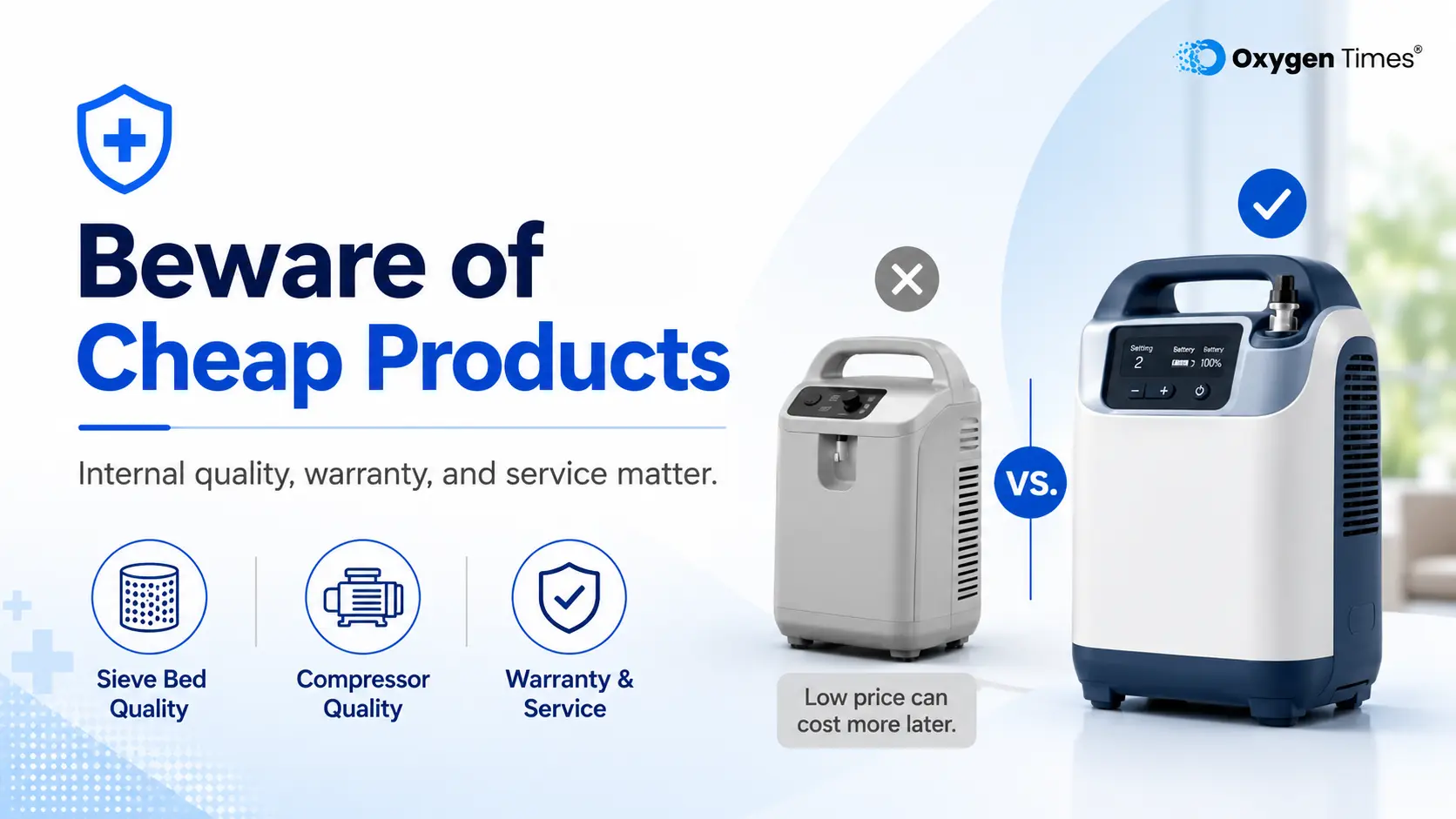
Many low-cost portable oxygen concentrators may look attractive because they show good specifications on paper. They may claim decent battery backup, lightweight design, multiple pulse settings, and a modern-looking body. However, in oxygen therapy, the real quality of the machine depends on what is inside the device, not only on what is written in the product listing.
Some very cheap machines may work reasonably well in the beginning, but long-term reliability can become a concern after regular use. The difference is often seen in areas such as compressor quality, sieve bed quality, oxygen purity stability, spare-part availability, warranty support, and after-sales service.
A typical giveaway is the warranty period. Many low-cost or weakly supported machines may offer only 1 year warranty, or in some cases, no clear warranty on the device. This usually indicates lower confidence in long-term performance and weaker after-sales responsibility.
Also, these machines may be called cheap, but they are still not a small purchase. Many low-cost portable oxygen concentrators still cost above ₹90,000. If a patient spends this much money on a machine that comes with limited warranty, weak service support, or poor long-term reliability, it may not be worth buying even if the initial price looks attractive.
Short Warranty and Weak Service Can Become Expensive
Low-cost machines may look affordable at the time of purchase, but the real problem often starts when service is needed. In some cases, users are told that spare parts are not available, or that repair may take another two to three months. Sometimes, instead of repairing the machine properly, the user may be pushed to buy a new machine because the seller does not have a strong service network or spare-part support.
This usually happens when the brand is not directly present in India, does not stock spare parts locally, or depends only on short-term sellers. For oxygen therapy users, this can be risky because machine downtime can directly affect the patient’s daily routine and travel plans. Before buying a very cheap portable oxygen concentrator, always check whether the brand is actively supported in India, who will provide warranty and repair support, whether spare parts are available, and whether the seller has real experience in oxygen therapy products.
Prefer a Trustworthy Brand and Seller
For a medical device like a portable oxygen concentrator, the seller’s experience is also important. A trustworthy source can help you understand which models are actually being used by patients, which models have better service support, and which machines are easier to maintain in India.
It is usually safer to prefer well-known global brands such as Inogen and Philips Respironics, or well-known Indian brands such as Oxysure and Oxymed, because buyers get better confidence in service support, spare-part availability, and long-term ownership.
At Oxygen Times, we regularly deal with portable oxygen concentrator users and track common issues such as battery replacement, sieve bed replacement, service delays, oxygen purity concerns, airline travel issues, and long-term spare-part availability.
Before buying, it is better to speak with an experienced oxygen therapy consultant instead of choosing only the cheapest model shown online.
If you are confused between multiple models, feel free to reach out to our consultants using the buttons below.
Buyer Tip:
Do not buy a portable oxygen concentrator only because it is the cheapest option online. Even low-cost POCs usually cost a significant amount, often above ₹90,000. If the machine has limited warranty, poor service support, weak compressor quality, poor sieve bed quality, unstable oxygen purity, or no reliable spare-part support, the lower price may not be worth it in the long run.
Prescription Comes First
Do not choose a portable oxygen concentrator only by flow setting or specifications. The main goal is to maintain the patient’s target SpO₂, usually around 90–95% or as advised by the doctor.
Check with your doctor what SpO₂ range you should maintain, then test the machine on the patient at the required setting. If SpO₂ is still dropping below the target, the patient may need a higher oxygen setting or a higher-capacity machine.
Final Verdict
Buying a portable oxygen concentrator in 2026 should not be based only on price, weight, or advertised battery backup. The right POC should match the patient’s oxygen need, help maintain the target SpO₂ advised by the doctor, and remain practical for daily use.
Before buying, check real battery backup, battery cost, charging time, weight with battery, sieve bed replacement, service support, spare-part availability, and airline battery permission.
For Indian buyers, long-term support matters a lot. A machine that looks cheaper today may become expensive later if it has weak internal parts, short warranty, poor service, or unavailable spare parts.
At Oxygen Times, our recommendation is simple: choose a POC that suits the patient’s actual oxygen need, is comfortable to carry, has practical battery backup, and comes from a trustworthy brand or seller with reliable support in India.
If you are confused between multiple models, feel free to reach out to our consultants using the buttons below.
FAQs
What is the difference between pulse dose and continuous flow?
Pulse dose delivers oxygen when the machine detects inhalation, while continuous flow delivers oxygen at a fixed flow rate. Pulse-dose machines are usually lighter and more battery-efficient, and in around 90% of regular daytime mobility cases, pulse flow works well for most users. Continuous-flow or dual-mode machines are usually heavier and may be needed for sleep or CPAP/BiPAP use.
How to check battery backup of a portable oxygen concentrator?
Most manufacturers market battery backup with the maximum “up to” value, which is usually calculated at the lowest pulse setting. Instead of checking only the maximum backup, ask for the backup range at different settings, such as setting 1, 3, 5, or the highest setting available in that machine. This gives a more practical idea of real battery performance.
How much does a portable oxygen concentrator battery cost?
Battery price depends on the brand and model. Many premium American POC batteries can cost around ₹50,000 to ₹70,000 in India, while Indian origin brands such as Oxysure and Oxymed usually offer batteries around ₹22,000 to ₹25,000. Prices may vary by model, battery type, and availability.
What is the ideal weight for a portable oxygen concentrator?
For regular outdoor use, many respiratory patients prefer machines below around 2.4 kg with battery installed. However, the right choice depends on oxygen requirement, battery backup, carrying comfort, and doctor’s advice.
Are user-replaceable sieve beds important?
Yes, user-replaceable sieve beds can make long-term maintenance easier and more affordable. They reduce dependency on service-centre visits and can be useful for frequent travellers or users living outside major cities. In many cases, users may save around ₹10,000 to ₹15,000 in service-related costs during the machine’s lifetime.
How long do sieve beds of a portable oxygen concentrator last?
Sieve bed life depends on usage, humidity, dust exposure, and machine maintenance. In many portable oxygen concentrators, sieve bed replacement is typically required around every 3,000 hours of use. This is why it is better to prefer models with user-replaceable sieve beds. Before buying, also ask about the sieve bed replacement cost and whether the part is easily available in India.
Which portable oxygen concentrators have user-replaceable sieve beds?
Some models such as Inogen Rove 6 and Oxysure Go offer user-replaceable sieve beds. Many other portable oxygen concentrators require service-centre replacement, so buyers should confirm this before purchase.
Should I buy a global brand or an Indian origin brand?
A global brand can be good, but only if it has active support, spare parts, and service availability in India. Before buying, check who handles warranty, where service is available, and whether batteries and sieve beds are easily available. Oxygen Times works as an aggregator and deals with almost all major brands, so our consultants can give you a fair idea about the right model based on usage, service support, and long-term ownership cost.
What is the difference between company-operated and distributor-operated service?
In company-operated service, the brand or company is directly involved in support. In distributor-operated service, warranty and spare parts depend heavily on the distributor. The problem is that distributors can change over time, and users may then face difficulty finding the right support channel, spare parts, or repair timeline. Brands such as Oxysure, Oxymed, Philips Respironics, and Inogen are commonly compared by buyers because long-term service presence matters as much as product specifications.
How to check airline approval for a portable oxygen concentrator?
Before travelling, check whether the POC model is airline-approved, whether the airline accepts that model, and whether you need to carry any product or travel documents. Also check the battery watt-hour rating separately because machine approval and battery permission are not the same thing. Batteries below 100 Wh are generally easier to carry, while 101–160 Wh batteries usually need airline approval and are limited to two spare batteries. Always confirm the final requirement directly with the airline before travel.
How much battery backup do I need for a flight?
Many airlines require enough battery backup for 150% of the expected flight duration. For example, for a 10-hour flight, you may need around 15 hours of battery backup based on the setting being used. Always calculate backup from the machine’s real battery performance at different settings, not only from the maximum “up to” backup shown in brochures.
Need help choosing the best Portable Oxygen Concentrator?
Our oxygen therapy experts are here to help you find the perfect match for your needs.
Need help choosing the best Portable Oxygen Concentrator?
Our oxygen therapy experts are here to help you find the perfect match for your needs.