Why Floating-Ball Flowmeters Are a Must-Have in Home Oxygen Concentrators

When choosing an oxygen concentrator for home use, most people look at oxygen purity, flow range, noise, power consumption, warranty and price. But there is one small component that often gets overlooked: the flowmeter.
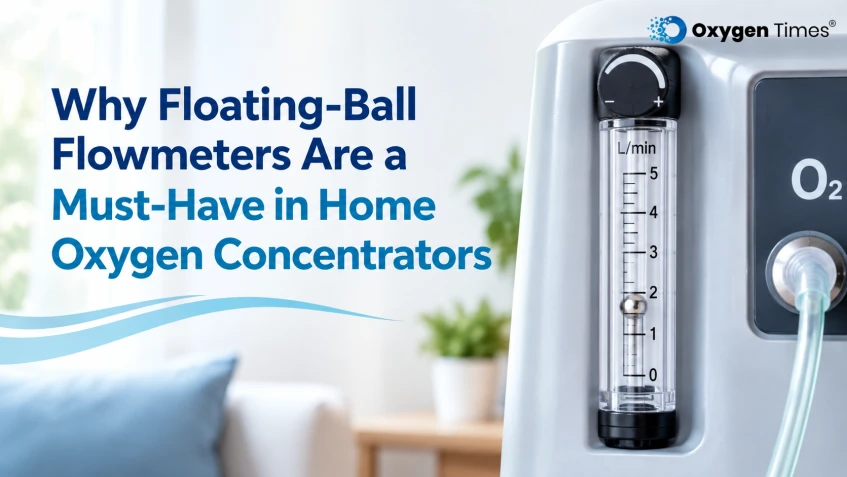
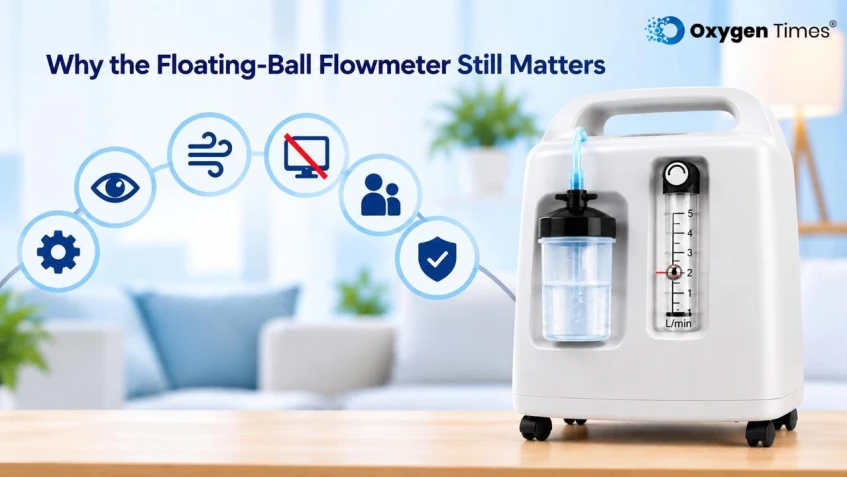
A flowmeter controls and displays the amount of oxygen being delivered by the concentrator. Traditionally, home and hospital oxygen concentrators have used a floating-ball flowmeter—a mechanical system in which a small ball floats inside a calibrated tube according to the flow of oxygen passing through it.
Today, some manufacturers are moving away from traditional floating-ball flowmeters. In some cases, they are being replaced by digital displays or electronic flow-control systems, either to reduce manufacturing costs or to give the product a more modern, high-tech appearance.
However, when it comes to oxygen therapy, simple does not necessarily mean outdated. In fact, a properly designed floating-ball flowmeter offers several important advantages, particularly for home oxygen users.
Key Takeaways
-
Floating ball flowmeters measure oxygen flow rate in litres per minute (LPM).
-
The transparent tube allows users to clearly observe the floating ball and read the oxygen flow rate.
-
The flow control knob enables easy adjustment of oxygen flow according to the prescribed setting.
-
The simple mechanical design makes the flowmeter easy to operate for patients and caregivers at home.
-
The visible floating ball helps users monitor the indicated oxygen flow rate during operation.
-
Regular calibration and maintenance help ensure accurate readings and reliable performance.
-
A reliable floating ball flowmeter improves flow monitoring and is an important feature when selecting a home oxygen concentrator.
What Is a Floating-Ball Flowmeter?
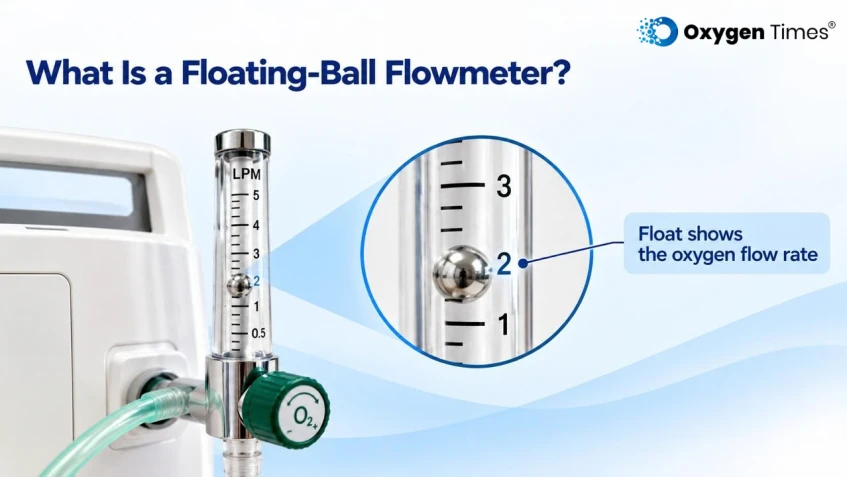
A floating-ball flowmeter is a mechanical device used to regulate and visually indicate oxygen flow.
Inside the transparent flowmeter is a calibrated tube containing a small metal or lightweight float. As oxygen flows through the tube, the float rises. The position of the float corresponds to the approximate oxygen flow rate, usually measured in litres per minute (LPM).
For example, if the flow is set to 2 LPM, the ball will settle around the 2 LPM marking.
The important point is that the position of the ball is determined by the oxygen passing through the flowmeter. This makes the floating-ball flowmeter much more than just a traditional-looking component.
Why Floating-Ball Flowmeters Are a Must-Have
1. Precise Micro-Adjustments Are Possible
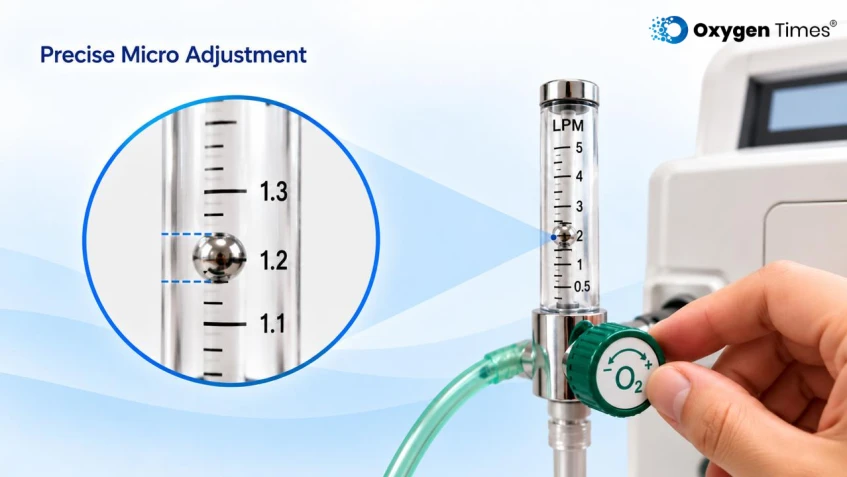
One of the biggest advantages of a good floating-ball flowmeter is the ability to make small adjustments to oxygen flow.
Many modern concentrators allow flow settings in increments as small as 0.1 LPM. This can be useful when a patient's prescribed oxygen requirement does not correspond neatly to a whole-number setting.
For example, instead of choosing only 1, 2 or 3 LPM, a flowmeter may allow settings such as 1.1, 1.2, 1.3, 1.4 and 1.5 LPM, depending on the design and calibration of the device.
This level of adjustment can be useful when oxygen therapy needs to be carefully titrated under medical supervision.
Importantly, patients should not independently change prescribed oxygen flow simply because the flowmeter allows fine adjustment. Oxygen flow should be set according to the treating physician's instructions.
2. Mechanical Systems Are Difficult to Manipulate
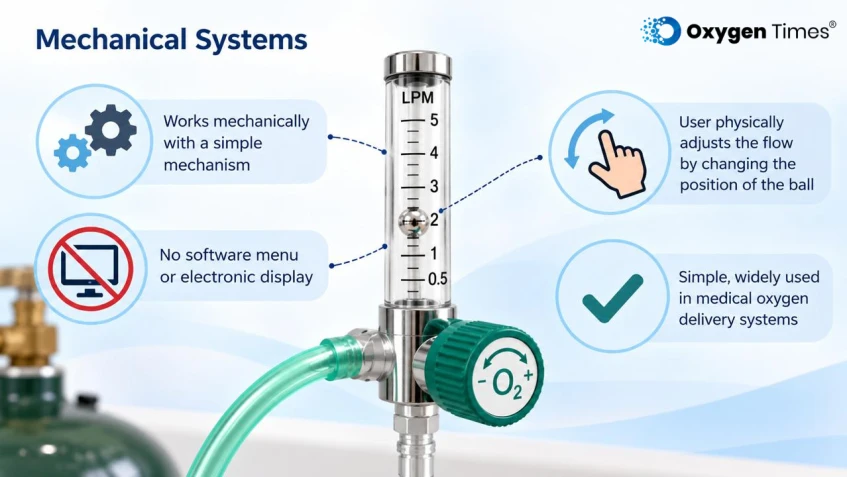
A second major advantage is the simplicity of the mechanism.
A traditional floating-ball flowmeter is fundamentally mechanical. There is no software menu, electronic display or digital setting that needs to be interpreted.
The user physically adjusts the flow control and observes the position of the ball.
This simplicity is one reason mechanical flowmeters remain widely used in medical oxygen delivery systems and healthcare environments.
There is also an important practical advantage: the indication is physically tied to the flow through the flowmeter. A digital display, on the other hand, can potentially show a programmed or electronically calculated value. That does not automatically mean the displayed value is wrong—well-designed electronic systems can be highly accurate—but the display itself is not necessarily an independent visual confirmation of the oxygen flow leaving the device.
For medical equipment, having a simple mechanical indication can therefore provide an additional layer of confidence.
3. You Can See the Flow Instead of Only Seeing the Setting
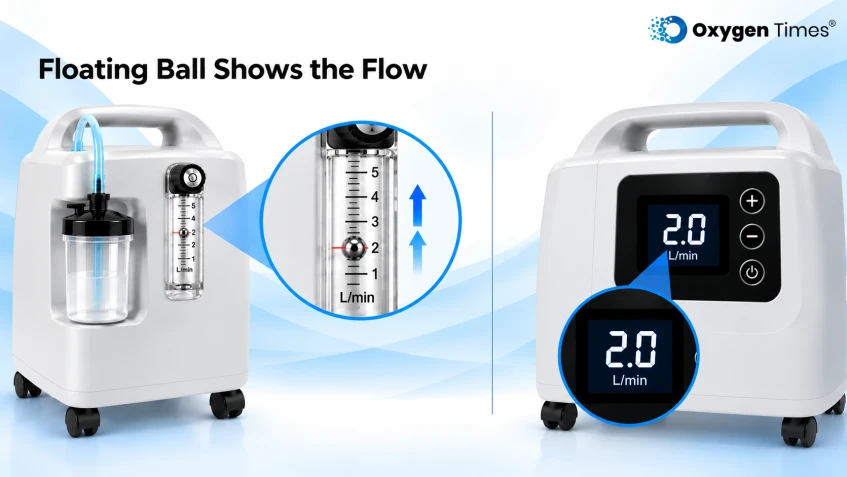
This is perhaps the most important advantage of a floating-ball flowmeter.
With a conventional mechanical flowmeter, the user can actually see the float moving inside the calibrated tube. The ball rises or falls depending on the oxygen flow passing through the system.
This is different from a digital interface that may simply display the selected or programmed flow rate.
For example, if a digital screen says 2.0 L/min, the user knows that the machine has been set to 2.0 L/min. But with a floating-ball flowmeter, the position of the ball provides a direct visual indication associated with oxygen flowing through the flowmeter.
This distinction becomes particularly relevant when buying or renting used, refurbished or rental oxygen concentrators.
A digital display can tell you what the machine is configured to display. A mechanical flowmeter provides a visible physical indication at the point where the oxygen is flowing. That makes it considerably harder to simply manipulate the displayed number to make the machine appear to be delivering a particular flow.
Digital Flowmeters Are Not Necessarily Bad
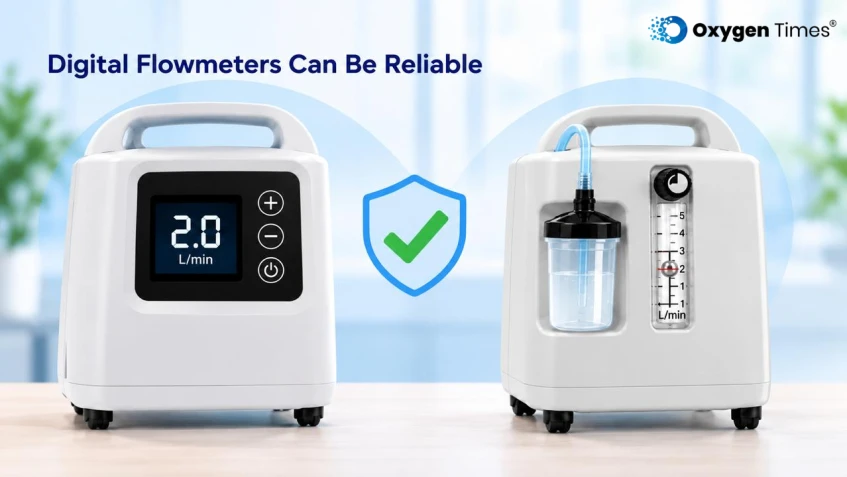
It is important to clarify that digital flowmeters are not inherently inaccurate or unsafe.
Modern electronic oxygen concentrators can use sophisticated sensors and control systems, and a properly designed and calibrated digital system can provide accurate information.
The issue is not simply: Mechanical = good, Digital = bad.
The more important question is: What exactly is the displayed number measuring, and can the user independently verify the delivered flow?
A digital display that accurately measures and controls actual oxygen flow can be perfectly suitable. However, a mechanical floating-ball flowmeter has an important advantage in transparency: you can physically observe the flow indication.
Why Hospitals Still Use Simple Mechanical Flowmeters
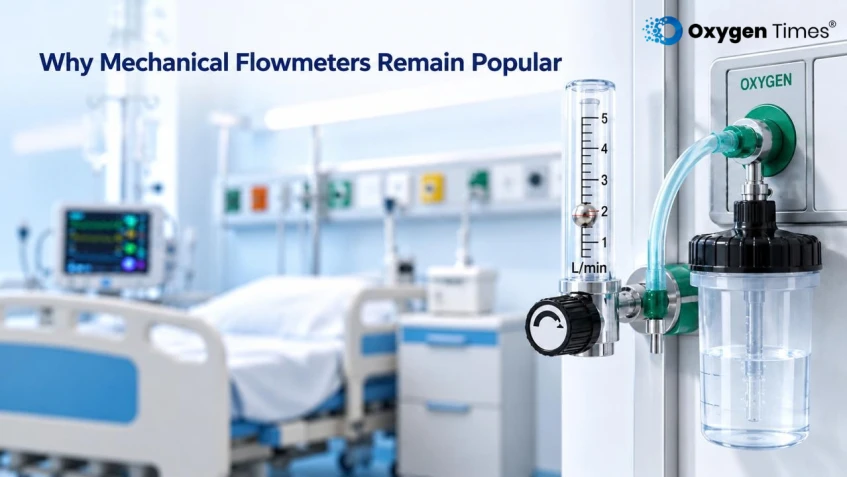
Walk into a hospital, clinic or healthcare facility and you will still find mechanical flowmeters widely used.
Why? Because medical equipment often prioritizes reliability, simplicity, ease of operation, visual confirmation, easy adjustment, minimal dependence on electronics and easy servicing.
A mechanical flowmeter does not require a software interface to tell you what is happening. You turn the knob, observe the ball and read the calibrated scale.
That simplicity has considerable value in healthcare.
Especially Important for Home Oxygen Therapy

For a hospital professional, a complicated electronic system may be perfectly manageable. For a patient or family member using an oxygen concentrator at home, however, simplicity and transparency become even more important.
A family member should be able to look at the concentrator and immediately understand: "This is the oxygen flow being indicated right now."
There is no need to navigate a digital menu or understand what a particular electronic reading represents.
The flowmeter is visible, intuitive and easy to understand.
The Bottom Line
The floating-ball flowmeter may look like an old-fashioned component in an increasingly digital world.
But in oxygen therapy, simple and transparent can be better than complicated and high-tech.
-
Fine flow adjustment
-
Easy visual monitoring
-
A mechanical indication associated with oxygen flow
-
Less dependence on software or electronic displays
-
Simple operation for patients and caregivers
-
Easy-to-understand readings
This is why a floating-ball flowmeter should not be viewed as a feature that manufacturers can simply remove in the pursuit of a more modern-looking oxygen concentrator.
For a home oxygen concentrator, it can be an important functional and safety-oriented feature.
And when choosing between two otherwise comparable oxygen concentrators, a clearly visible, properly calibrated mechanical floating-ball flowmeter can be a feature worth prioritizing.
Technical Note
A floating-ball flowmeter provides a mechanical indication of flow through the flowmeter and, like any measuring device, its accuracy depends on proper calibration, installation, operating conditions and the specifications of the particular flowmeter. It should not be interpreted as an absolute guarantee of delivered oxygen flow.
Need help choosing the best Oxygen Concentrator?
Our oxygen therapy experts are here to help you find the perfect match for your needs.
Need help choosing the best Oxygen Concentrator?
Our oxygen therapy experts are here to help you find the perfect match for your needs.