Philips Oxygenate 5 Review 2026: Specs, Oxygen Output & EverFlo Comparison

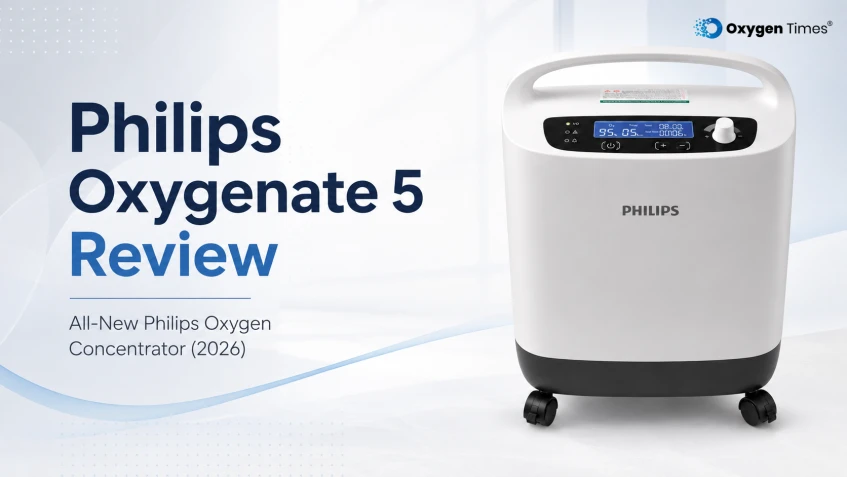
For home oxygen therapy, an oxygen concentrator needs to be reliable, easy to use, and suitable for everyday use. Philips is a familiar name in this category, with the EverFlo being a widely used stationary oxygen concentrator.
The Philips Oxygenate 5 is a new launch after almost 2 decades and the successor to the highly successful EverFlo. It offers a similar oxygen flow range and oxygen purity, so the key question is: what has changed?
In this review, we look at the Oxygenate 5’s design, controls, oxygen monitoring, power use, and everyday usability, and how it compares with the EverFlo.
Key Takeaways
- The Philips Oxygenate 5 provides continuous oxygen flow from 0.5 to 5 LPM, making it suitable for different prescribed oxygen flow requirements.
- Philips specifies an oxygen purity of 93% ±3%.
- The machine has a digital flowmeter and display, making the selected oxygen flow easier to read.
- The oxygen flow can be adjusted in 0.1 LPM increments, allowing for more precise flow adjustment.
- An Oxygen Percentage Indicator (OPI) monitors the oxygen concentration while the machine is running.
- The machine includes an alarm that alerts the user if oxygen purity falls below the specified level.
- A turn-off timer of up to 10 hours allows the machine to stop automatically after the selected time.
- The Oxygenate 5 uses a nine-level filtration system, including a replaceable air-inlet filter.
- The machine weighs approximately 18 kg, making it heavier than the EverFlo, which weighs around 14 kg.
- Philips lists the Oxygenate 5’s power consumption as less than 330 VA.
- One of the most noticeable changes from the EverFlo is the move from its floating-ball flowmeter to a digital flow-control system.
- For existing EverFlo users, the Oxygenate 5 is worth considering if they want newer features such as digital flow control, oxygen monitoring, and an updated control panel.
Philips Oxygenate 5 vs EverFlo: What Has Changed?
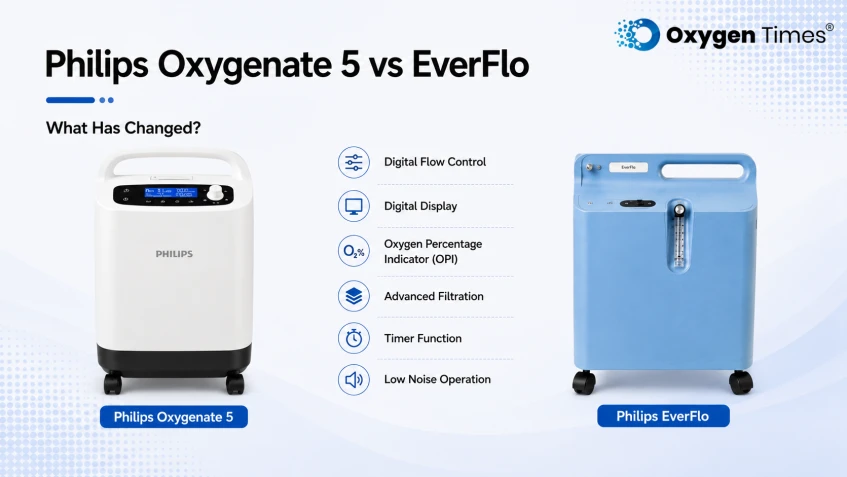
The Philips Oxygenate 5 keeps the basic purpose of the EverFlo but brings several noticeable changes in how the machine looks, works, and gives information to the user. The biggest differences can be seen in the control panel, oxygen monitoring, and overall design.
One of the first things you notice is the control panel. The EverFlo uses a traditional floating-ball flowmeter, while the Oxygenate 5 uses a rotary control knob and digital display. This makes it easier to see the selected oxygen flow. The display also shows information such as therapy time and total operating hours.
Another useful addition is oxygen concentration monitoring. The Oxygenate 5 has an Oxygen Percentage Indicator (OPI) that monitors the oxygen concentration while the machine is running.
Oxygen flow
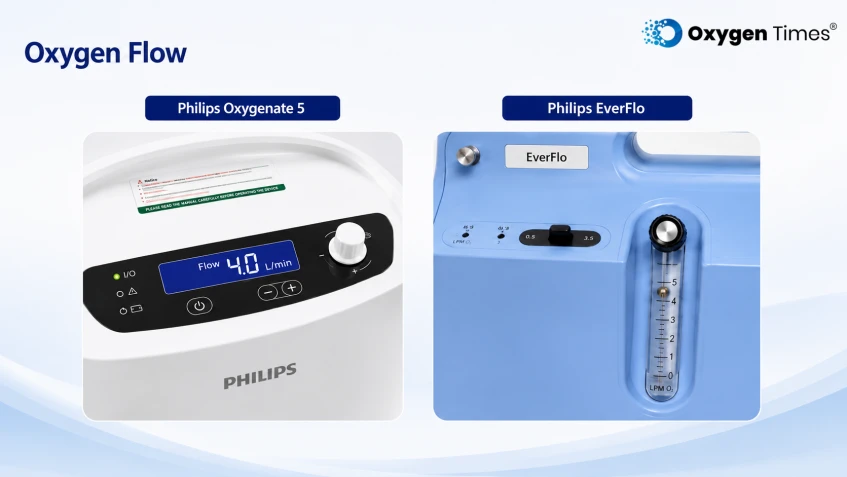
The Philips Oxygenate 5 offers a 0.5–5 L/min flow range, adjustable in precise 0.1 LPM increments. The Philips EverFlo provides a 0.5–5 L/min flow range through a traditional flowmeter.
Oxygen Purity
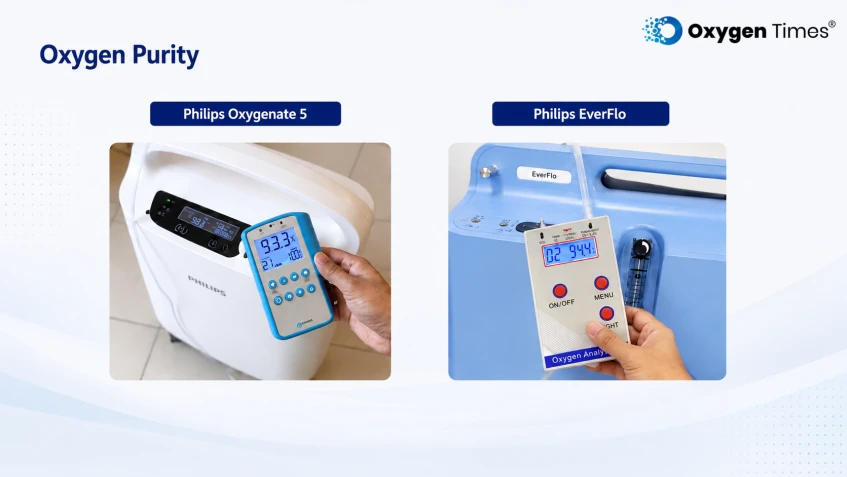
The Philips Oxygenate 5 provides an oxygen purity of 93% ±3%, while the Philips EverFlo also delivers 93% ±3% oxygen purity.
Flow Control
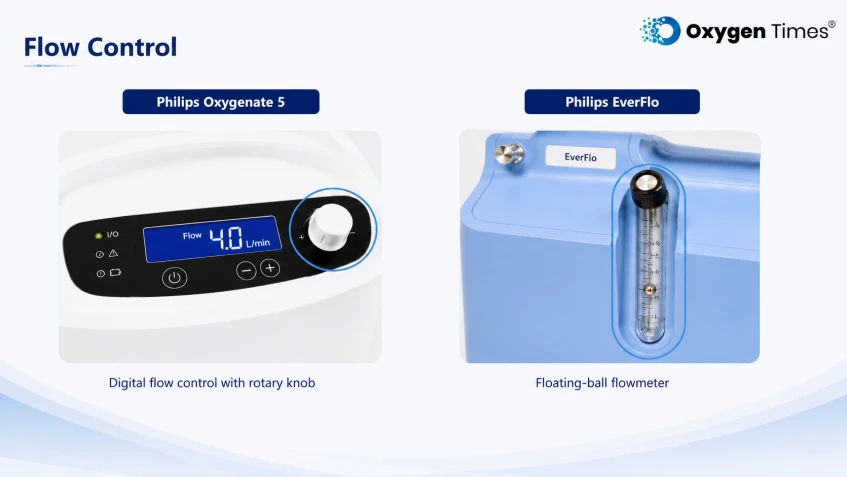
The Philips Oxygenate 5 features digital flow control with a rotary knob, allowing precise 0.1 LPM adjustments. The Philips EverFlo uses a traditional floating-ball flowmeter for manual flow adjustment.
Display
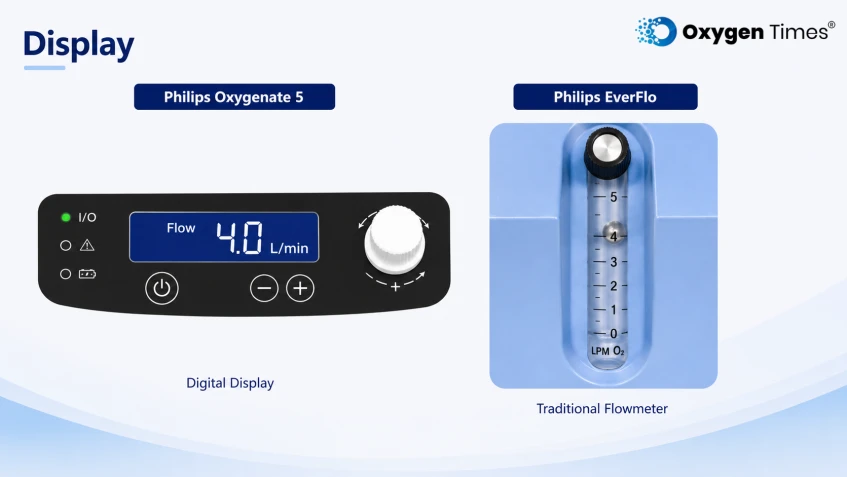
The Philips Oxygenate 5 features a clear digital display for flow and therapy information. The Philips EverFlo uses a traditional flowmeter to indicate the selected flow rate.
Oxygen Monitoring
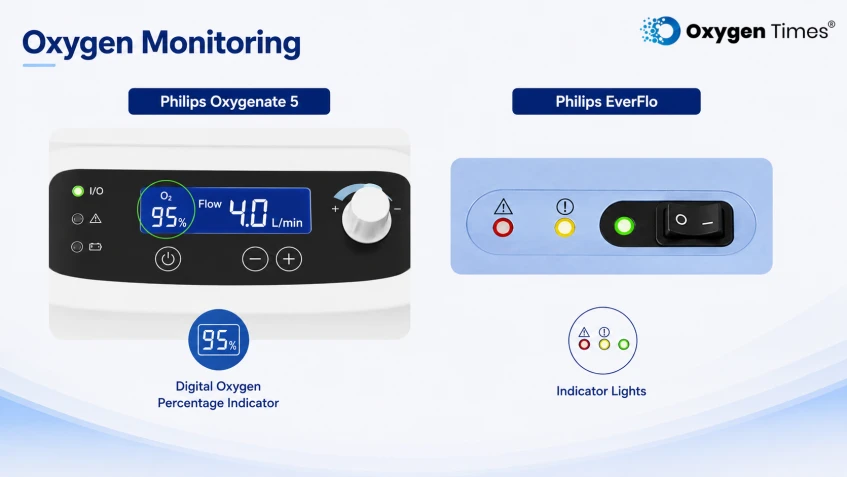
The Philips Oxygenate 5 features a digital oxygen percentage indicator that displays oxygen concentration on the screen. The Philips EverFlo uses indicator lights to show oxygen status.
Weight
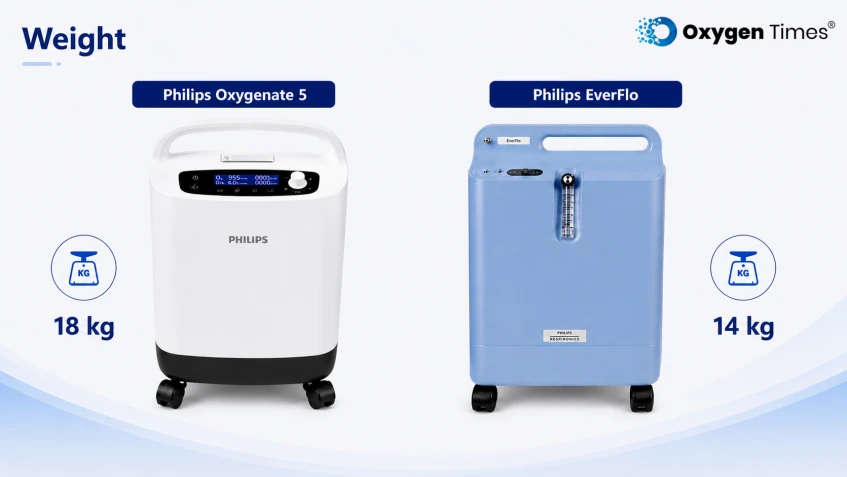
The Philips Oxygenate 5 weighs 18 kg, making it 4 kg heavier than the Philips EverFlo at 14 kg.
Noise
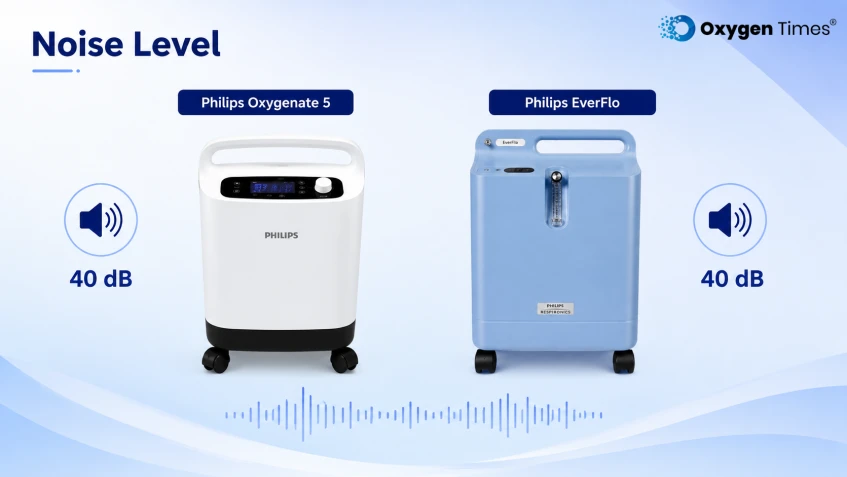
Both the Philips Oxygenate 5 and EverFlo operate at around 40 dB. So there was no noticeable difference in noise levels between the two.
Power Consumption
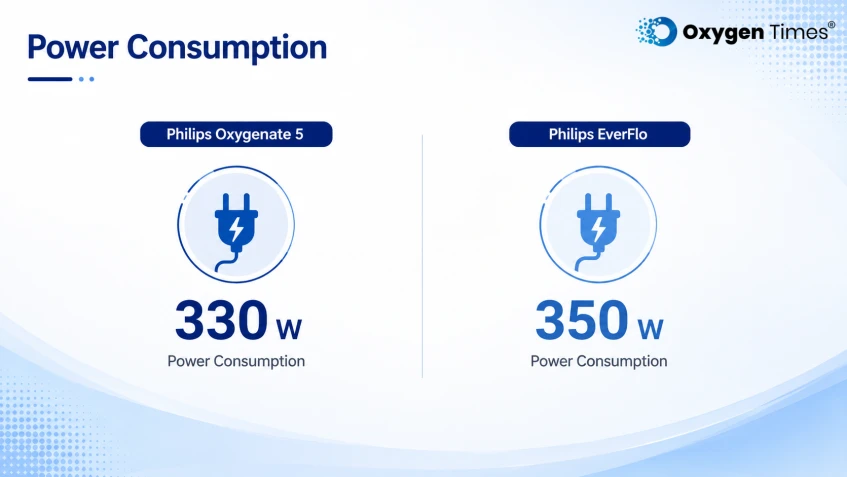
The Philips Oxygenate 5 consumes around 330 W, while the Philips EverFlo consumes around 350 W. The Oxygenate 5 uses slightly less power during operation.
Operating Mode
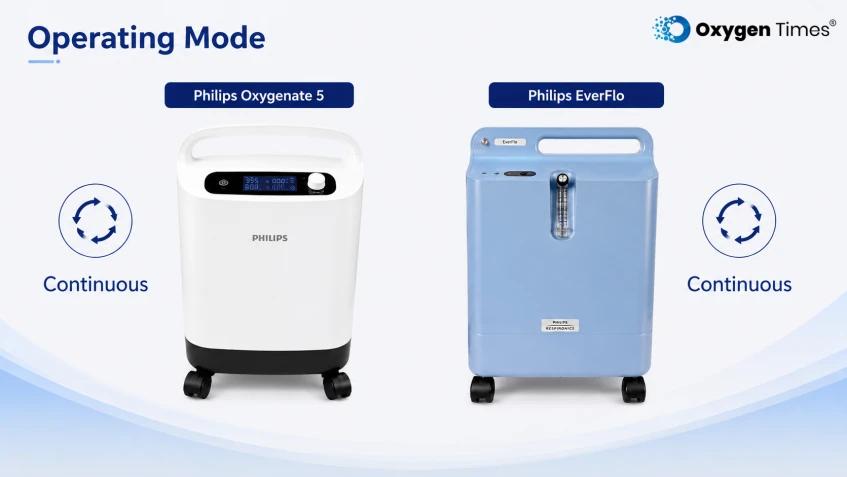
Both the Philips Oxygenate 5 and Philips EverFlo operate in continuous mode, providing a continuous flow of oxygen during use.
Filtration
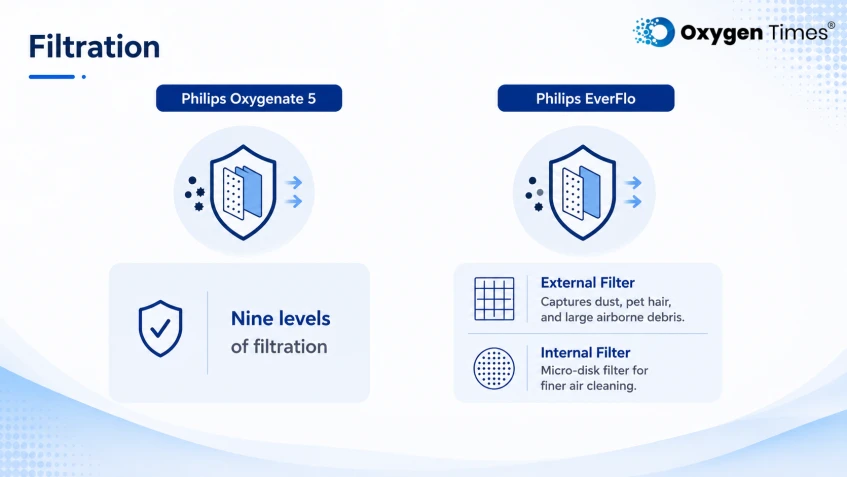
The Philips Oxygenate 5 uses a nine-level filtration system with two washable foam filters, while the Philips EverFlo uses separate external and internal filters. The Oxygenate 5 filters should be washed every 500 hours and replaced every two years.
Timer
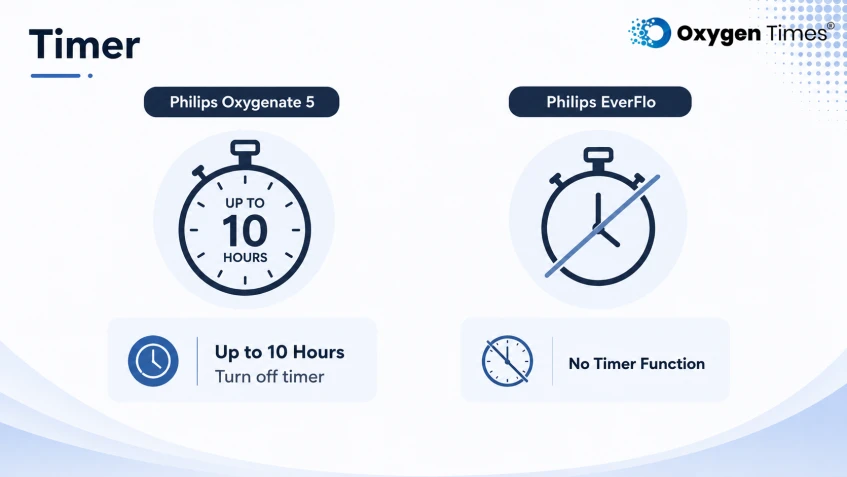
The Philips Oxygenate 5 features a turn-off timer of up to 10 hours, while the Philips EverFlo does not have a built-in timer function.
Key Comparison Table
| Feature | Philips Oxygenate 5 | Philips EverFlo |
|---|---|---|
|
Oxygen flow |
0.5-5 LPM |
0.5-5 LPM |
|
Oxygen purity |
93% ±3% |
93% ±3% |
|
Flow control |
Digital flow control with rotary knob |
Floating- ball flowmeter |
|
Display |
Digital display |
Traditional flowmeter |
|
Oxygen monitoring |
Oxygen percentage indicator |
EverFlo oxygen monitoring depends on model |
|
Weight |
18kg |
14kg |
|
Noise |
40dB |
40dB |
|
Power consumption |
330 W |
350W |
|
Operating mode |
Continuous |
Continuous |
|
Filtration |
Nine levels of filtration |
- |
|
Timer |
Turn off timer upto 10hrs |
- |
The Oxygenate 5 has a modern, rounded body and angled control panel, giving it a different look from the EverFlo. At around 18 kg, it is also heavier than the EverFlo, which weighs about 14 kg.
The redesigned interface makes information easier to see and understand, with features such as digital controls and oxygen monitoring. These changes offer a more modern user experience compared with the older EverFlo.
Flow Output Control: Control Knob vs Floating-Ball Flowmeter
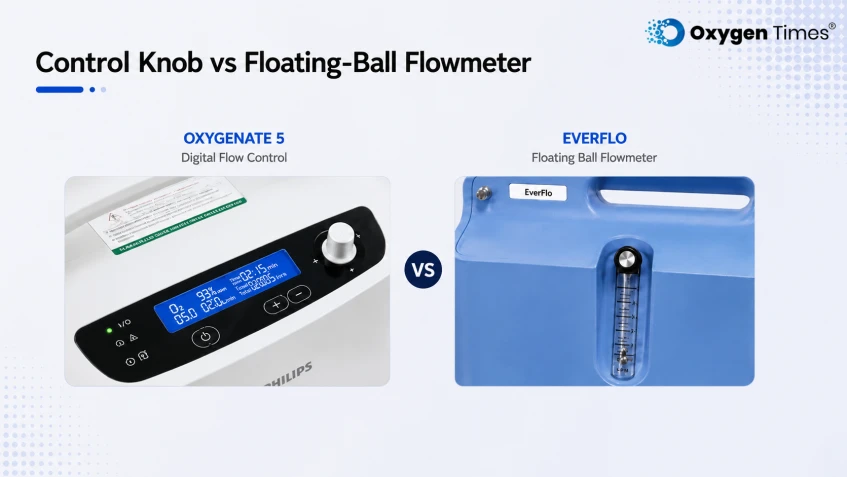
The Oxygenate 5 replaces the EverFlo’s floating-ball flowmeter with a rotary control knob and digital display.
- The Oxygenate 5 allows adjustment from 0.5 to 5 LPM in 0.1 LPM increments.
- The digital display shows the selected flow rate.
- An audible beep confirms each adjustment.
- The EverFlo shows flow through the position of its floating ball.
- Users familiar with the EverFlo may need some time to adapt to the digital controls.
Overall, the Oxygenate 5 offers more precise digital control, while the EverFlo keeps a simple, familiar setup.
Purity Indicator and Digital Display
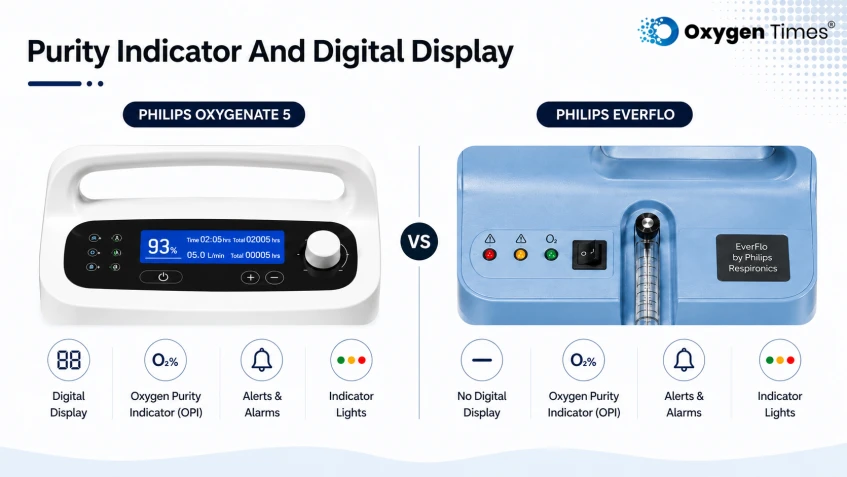
The digital display is one of the main changes in the Oxygenate 5. Its angled position makes the information easier to see while using the machine, without having to bend down to read it.
The display shows the selected oxygen flow rate and also provide information such as the therapy session timer and total operating hours. This gives the user a quick view of the machine’s settings and usage information.
Another useful feature is the Oxygen Percentage Indicator (OPI). It monitors the oxygen concentration while the machine is running. If the oxygen purity falls below the specified level, the machine provides an alert to notify the user.
The Oxygenate 5 also has indicator lights for power, oxygen purity, and system faults. If a fault occurs, the machine can provide an audible alarm and display an error code, helping the user identify that attention may be needed.
Oxygen Output and Purity
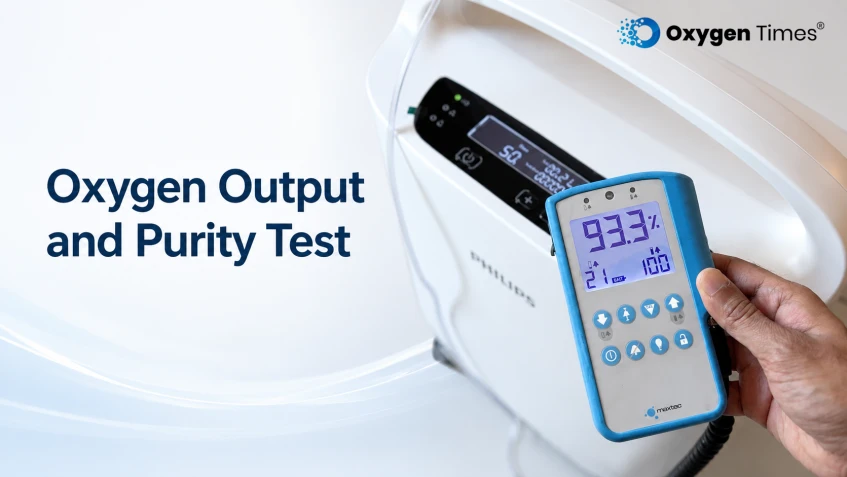
The Philips Oxygenate 5 provides continuous oxygen flow from 0.5 to 5 LPM. Philips specifies an oxygen concentration of 93% ±3%, which is the stated purity range for the machine.
The specifications also list oxygen concentration of 95% at 1–4 LPM and 93% at 5 LPM, under the specified test conditions. This shows that the oxygen concentration can vary slightly depending on the selected flow rate.
To see how the machine performs across its flow range, oxygen purity is checked at different flow rates from 0.5 to 5 LPM using a calibrated oxygen analyzer. The readings remained close to 93% across the tested flow rates, staying within the specified range.
This is an important part of the review because oxygen purity is one of the main things to consider when choosing an oxygen concentrator. The Oxygenate 5 is not only about its new design and digital features; it also delivers oxygen consistently across its usable flow range.
The Oxygenate 5 maintained stable oxygen purity across the tested flow rates, which supports its primary purpose as a stationary oxygen concentrator.
Build Quality
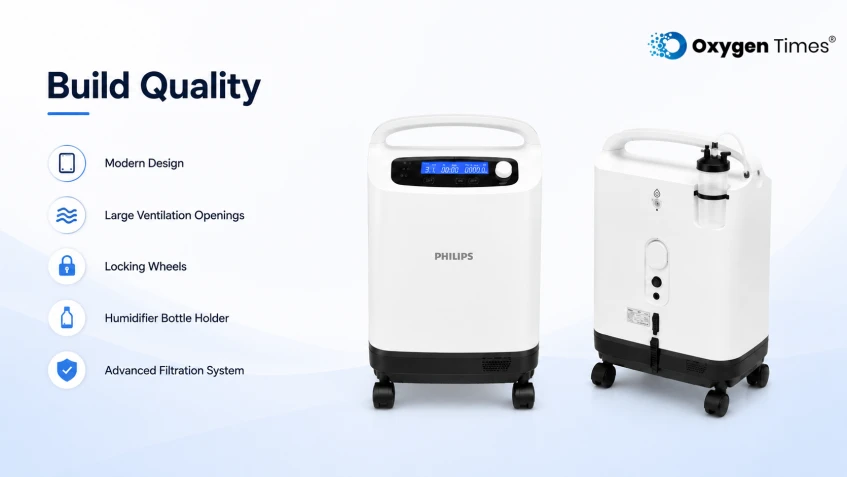
- The Oxygenate 5 has a more modern design than the EverFlo, with rounded edges, a cleaner finish, and an angled control panel.
- Large side ventilation openings support airflow, while locking wheels help keep the machine securely in place.
- A rear humidifier bottle holder keeps the bottle securely positioned during use.
- The Oxygenate 5 uses a nine-level filtration system, including a patient-replaceable air-intake filter.
- It also includes two washable foam filters, which should be cleaned at the recommended intervals and dried completely before reuse.
- The filter sponge should be checked and cleaned regularly, with cleaning recommended at around 500 hours of use. Filter replacement depends on usage and environment, with replacement recommended at least every two years.
Weight and Dimensions
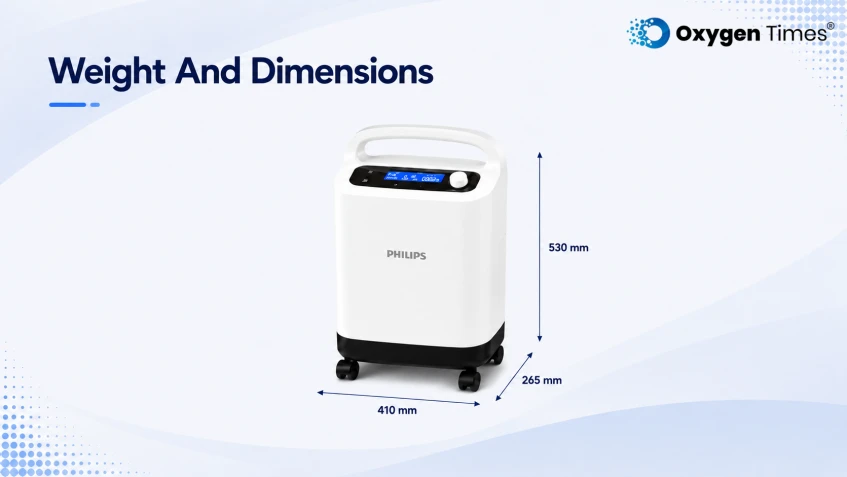
The Philips Oxygenate 5 weighs around 18 kg and measures 410 × 265 × 530 mm. This makes it a fairly substantial machine, as you would expect from a stationary oxygen concentrator designed for home use.
Compared with the EverFlo, which weighs around 14 kg, the Oxygenate 5 is about 4 kg heavier. If the machine will stay in one room, this difference may not matter much. However, if you need to move it between rooms regularly, the extra weight is something to consider.
The Oxygenate 5 has locking wheels that make it easier to move the machine into position and keep it securely in place once positioned. Even with the wheels, it is best to choose a suitable location for the machine before use, particularly if it will remain there for long periods.
Power Consumption
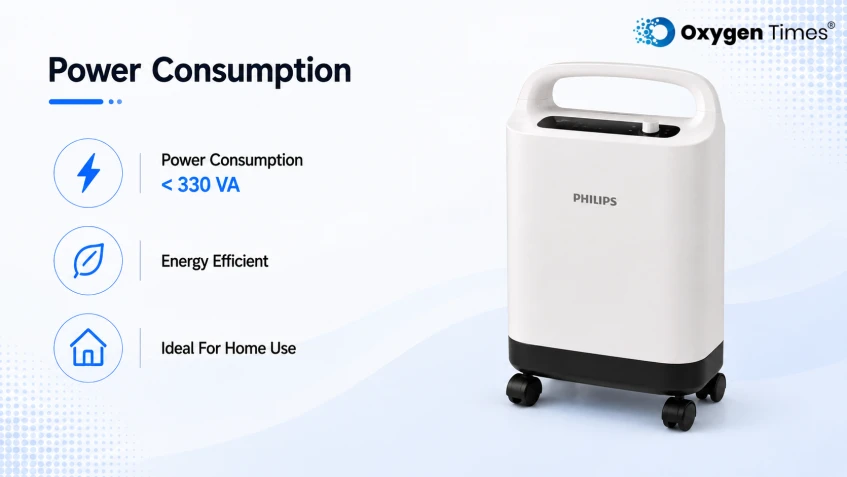
The Philips Oxygenate 5 has a specified power consumption of less than 330 VA. This is the amount of electrical power the machine is designed to use while operating.
For a stationary oxygen concentrator that may run for several hours a day, power consumption is worth considering because it can affect overall electricity use. The Oxygenate 5 is designed for continuous home use, so understanding its power requirement can help users plan for regular operation.
Compared with the EverFlo, the difference in power use is relatively small. Therefore, power consumption alone may not be a major reason to switch from an EverFlo to the Oxygenate 5. Other factors, such as the digital controls, oxygen monitoring, and overall ease of use, may be more important when deciding between the two.
Power-Cut Performance
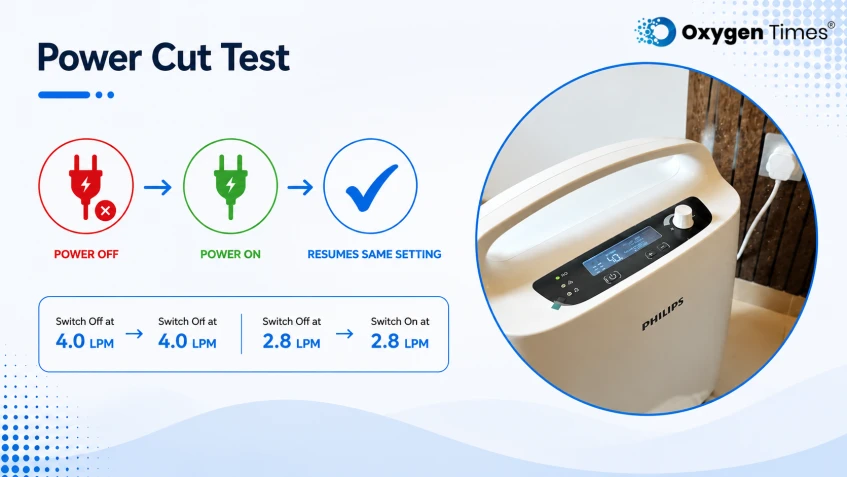
Power-cut performance is different from power consumption. For a home oxygen concentrator, it is useful to know what happens when the electricity supply is interrupted and then restored.
The Oxygenate 5 can resume the previously selected oxygen flow setting after a power interruption. During testing, the machine was set to 4 LPM before the power supply was disconnected. When power was restored, it restarted at the same 4 LPM setting without requiring the flow to be adjusted again. Similarly, when the machine was set to 2.8 LPM, it resumed at 2.8 LPM after the power was restored.
This feature is useful during short power interruptions, as the machine automatically resumes the previously selected oxygen flow without requiring manual adjustment.
Operating Conditions
When using a stationary oxygen concentrator at home, the surrounding environment is just as important as the machine’s oxygen output and controls. The Philips Oxygenate 5 is designed to operate within specific environmental conditions, so it is worth knowing these limits before deciding where to place the machine.
Environmental Operating Conditions
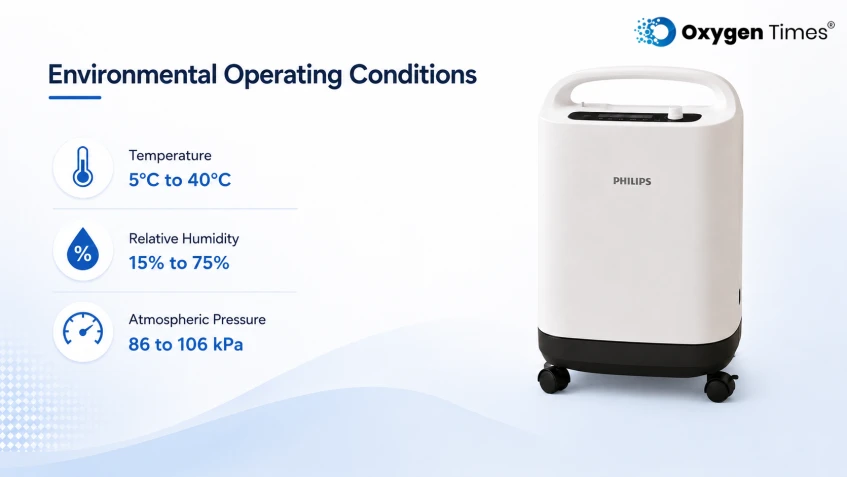
The Oxygenate 5 operates at 5°C to 40°C, with 15% to 75% relative humidity and atmospheric pressure of 86 to 106 kPa. Keeping the machine within these conditions helps it perform as intended.
IP21 Protection Rating
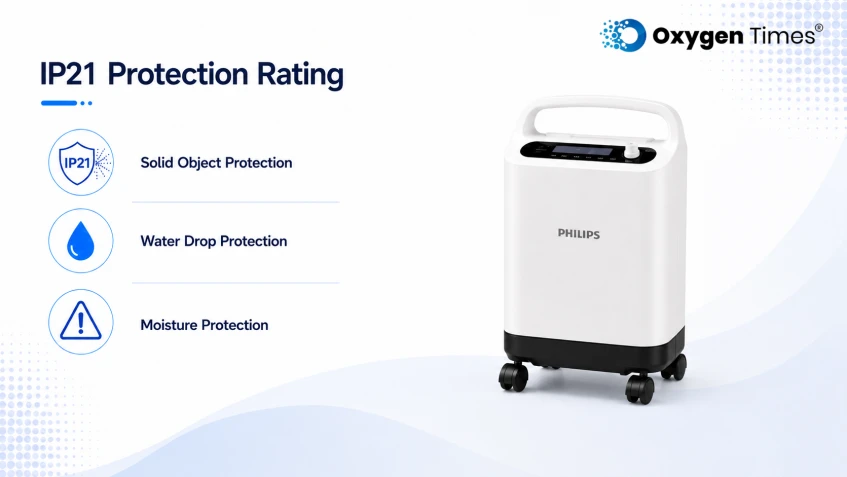
The Oxygenate 5 has an IP21 protection rating, protecting it from solid objects larger than 12.5 mm and vertically falling water drops. However, it is not waterproof, so keep it away from spills and excessive moisture.
Safety Tips for Everyday Use
Keep the air inlet and outlet clear and place the concentrator in a clean, dry and well-ventilated area. Keep it away from smoking, open flames, sparks and other ignition sources, as oxygen can support combustion.
Warranty and Long-Term Reliability
The Philips Oxygenate 5 is designed for regular, long-term use at home, so warranty coverage and routine maintenance are important considerations when choosing the machine.
Warranty coverage is another important factor to consider. Philips’ global product information lists 10,000 hours or 3 years of warranty coverage for the Oxygenate 5.
For comparison, the EverFlo comes with a 3-year warranty, which has been one of its advantages. This makes the warranty an important point for existing EverFlo users considering whether the Oxygenate 5 offers enough additional features to justify an upgrade.
The Oxygenate 5 has an expected product lifespan of five years. This is different from its warranty period—the lifespan refers to how long the device is designed to remain in service, while the warranty covers the manufacturer’s specified warranty period.
FDA Approval and Availability
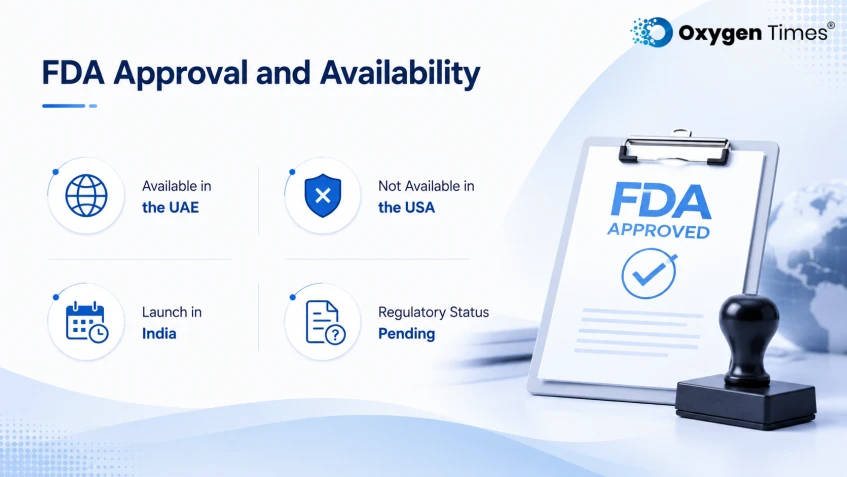
The Philips Oxygenate 5 is currently available in the UAE, with its official launch in India expected in the last quarter of 2026. The device is not currently available for sale in the United States. This may be related to its regulatory status, as FDA clearance for the Oxygenate 5 could not be confirmed.
Manufacturing Transparency: Who Makes the Oxygenate 5?
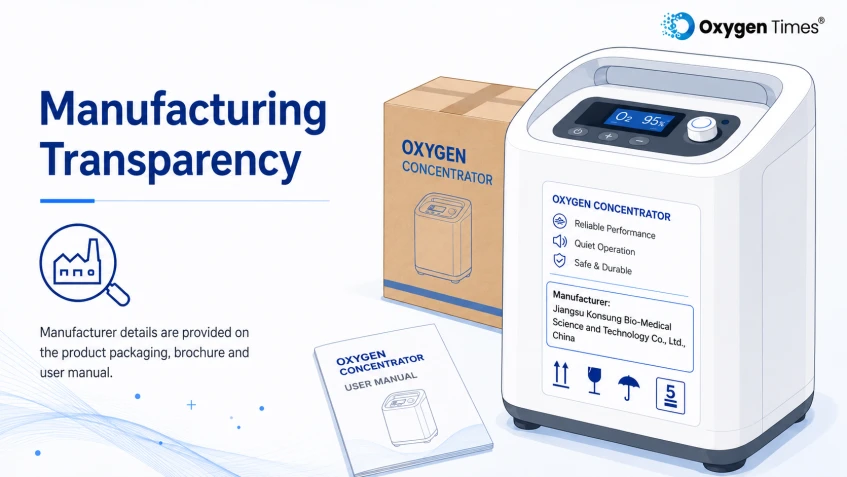
When buying an oxygen concentrator, it is natural to want to know who actually makes the machine. For the Oxygenate 5, Philips clearly identifies Jiangsu Konsung Bio-Medical Science and Technology Co., Ltd., China as the manufacturer.
This information is provided on the product packaging, brochure, and user manual, so buyers do not have to guess where the machine comes from or who is responsible for its manufacture.
Knowing the manufacturer can also be useful when looking for service, replacement filters, spare parts, or other support after purchase. For buyers considering the Oxygenate 5, this makes the product’s manufacturing details clear from the start.
What’s in the Box
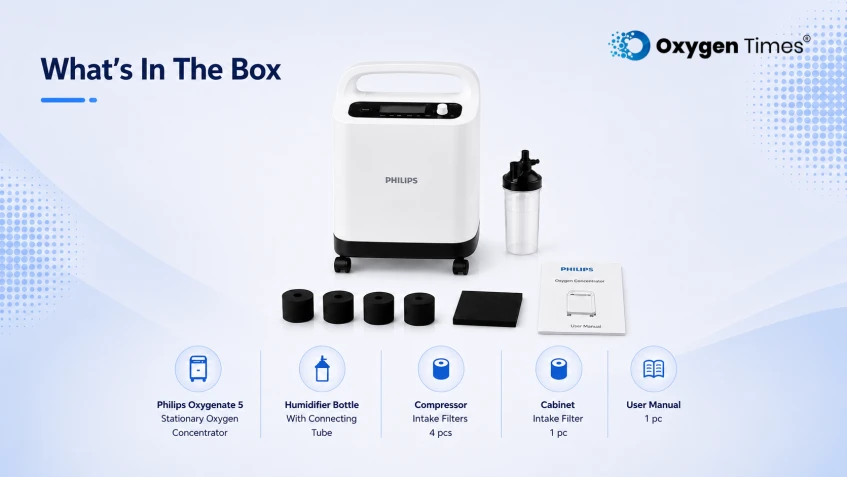
The Philips Oxygenate 5 comes with the essential accessories needed for setup and everydayUse.
The package include:
- Philips Oxygenate 5 stationary oxygen concentrator
- Humidifier bottle with connecting tube
- Compressor intake filters – 4 pcs
- Cabinet intake filter
- User Manual
Final Verdict
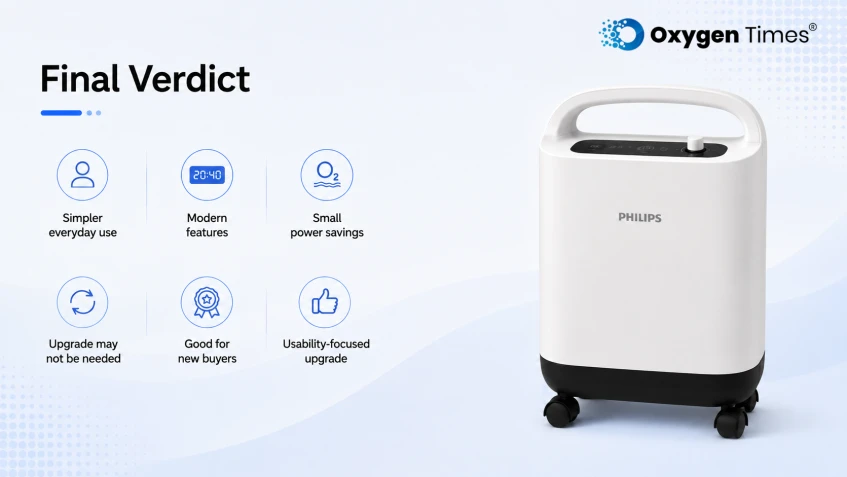
After looking at the Philips Oxygenate 5 as a whole, its biggest advantage is its focus on making everyday use simpler and more convenient.
The digital display, rotary flow control, oxygen monitoring, turn-off timer, and updated filtration system give it a more modern feel than the EverFlo.
The Oxygenate 5 is heavier than the EverFlo, and users who prefer the traditional floating-ball flowmeter may miss it. The improvement in power consumption is also relatively small.
For existing EverFlo users, an upgrade may not be necessary if their current device is working well. However, for new buyers looking for a stationary oxygen concentrator with modern controls and convenient day-to-day operation, the Oxygenate 5 is a strong recommendation.
For whom is the Philips Oxygenate 5 best suited?
The Philips Oxygenate 5 is best suited for new buyers looking for a stationary oxygen concentrator with modern controls, oxygen monitoring, and easier day-to-day operation.
Overall, the Oxygenate 5 feels more like a thoughtful upgrade in usability and features than a major change in basic oxygen delivery.
Frequently Asked Questions
What is the oxygen flow rate of the Philips Oxygenate 5?
The Philips Oxygenate 5 provides continuous oxygen flow from 0.5 to 5 LPM. The flow can be adjusted in 0.1 LPM increments, allowing users to set the prescribed oxygen flow more precisely.
What is the oxygen purity of the Philips Oxygenate 5?
Philips specifies an oxygen concentration of 93% ±3% for the Oxygenate 5. The specifications also list oxygen concentration of 95% at 1–4 LPM and 93% at 5 LPM under specified test conditions.
Is the Philips Oxygenate 5 a continuous-flow oxygen concentrator?
Yes. The Philips Oxygenate 5 is a continuous-flow stationary oxygen concentrator that delivers oxygen from 0.5 to 5 LPM. It is designed primarily for home use rather than frequent travel.
What is the difference between the Philips Oxygenate 5 and EverFlo?
The biggest differences are the digital flow-control system, digital display, Oxygen Percentage Indicator (OPI), timer and updated filtration system on the Oxygenate 5. The EverFlo uses a traditional floating-ball flowmeter, while the Oxygenate 5 uses a rotary knob and digital display.
Is the Philips Oxygenate 5 better than the Philips EverFlo?
The Oxygenate 5 offers a more modern interface than the EverFlo, including digital flow control, oxygen monitoring and a turn-off timer. However, both provide continuous oxygen flow up to 5 LPM, and existing EverFlo users may not need to upgrade if their current machine is working well.
Does the Philips Oxygenate 5 show oxygen purity on the display?
The Philips Oxygenate 5 includes an Oxygen Percentage Indicator (OPI) that monitors oxygen concentration while the machine is operating. It can also alert the user if the oxygen purity falls below the specified level.
What information does the Philips Oxygenate 5 digital display show?
The digital display shows the selected oxygen flow rate, therapy session time and total operating hours. The machine also has indicators for power, oxygen purity and system faults, along with audible alarms and error codes when attention may be required.
How much does the Philips Oxygenate 5 weigh?
The Philips Oxygenate 5 weighs approximately 18 kg and measures 410 × 265 × 530 mm. It is about 4 kg heavier than the Philips EverFlo, which weighs around 14 kg.
How much electricity does the Philips Oxygenate 5 consume?
Philips specifies power consumption of less than 330 VA for the Oxygenate 5. As it is designed as a stationary oxygen concentrator for regular home use, electricity consumption should be considered when the machine is operated for several hours each day.
What happens to the Philips Oxygenate 5 after a power cut?
During testing, the Philips Oxygenate 5 was able to resume the previously selected oxygen flow setting after power was restored. For example, when it was set to 4 LPM before the power interruption, it restarted at the same 4 LPM setting after electricity returned.
Does the Philips Oxygenate 5 have a timer?
Yes. The Philips Oxygenate 5 has a turn-off timer of up to 10 hours. This allows the concentrator to stop automatically after the selected period.
How noisy is the Philips Oxygenate 5?
The Philips Oxygenate 5 has a typical sound level of less than 40 dB. In practical testing, both the Oxygenate 5 and Philips EverFlo produced around 40 dB of noise, so the difference in everyday noise levels was small.
What is the warranty on the Philips Oxygenate 5?
Philips' global product information lists a warranty of 10,000 operating hours or 3 years for the Oxygenate 5. The machine has an expected product lifespan of approximately five years, which is separate from its warranty period.
Is the Philips Oxygenate 5 available in India?
As of August 2026, the Philips Oxygenate 5 is available in the UAE, while its official launch in India is expected in the last quarter of 2026. Availability may vary by market and seller.
Who manufactures the Philips Oxygenate 5?
The Philips Oxygenate 5 is manufactured by Jiangsu Konsung Bio-Medical Science and Technology Co., Ltd., China. The manufacturer information is identified on the product documentation and packaging.
Is the Philips Oxygenate 5 FDA approved?
FDA clearance for the Philips Oxygenate 5 could not be confirmed at the time of this review. As of August 2026, the Oxygenate 5 is also not currently available for sale in the United States.
How often should the filters of the Philips Oxygenate 5 be cleaned or replaced?
The Oxygenate 5 includes washable foam filters and a patient-replaceable air-inlet filter. The filter sponge should be checked and cleaned at the recommended intervals, with cleaning required at around every 500 hours of use. Filter replacement depends on usage and environmental conditions, but replacement is recommended at least every two years.
What comes in the box with the Philips Oxygenate 5?
The Philips Oxygenate 5 package includes the stationary oxygen concentrator, humidifier bottle with connecting tube, four compressor intake filters, a cabinet intake filter, and a user manual. Oxygen Times provides a nasal cannula free with this machine.
Who should consider buying the Philips Oxygenate 5?
The Philips Oxygenate 5 is best suited for new buyers looking for a stationary oxygen concentrator with modern controls, oxygen monitoring and convenient day-to-day operation. Existing EverFlo users may not need to upgrade solely for oxygen delivery if their current machine is performing well.
Is the Philips Oxygenate 5 suitable for home use?
Yes. The Philips Oxygenate 5 is designed primarily as a stationary oxygen concentrator for home use. It provides continuous flow up to 5 LPM, has locking wheels for positioning, digital controls, oxygen monitoring and a filtration system intended for regular operation.
Need help choosing the best Oxygen Concentrator?
Our oxygen therapy experts are here to help you find the perfect match for your needs.
Need help choosing the best Oxygen Concentrator?
Our oxygen therapy experts are here to help you find the perfect match for your needs.